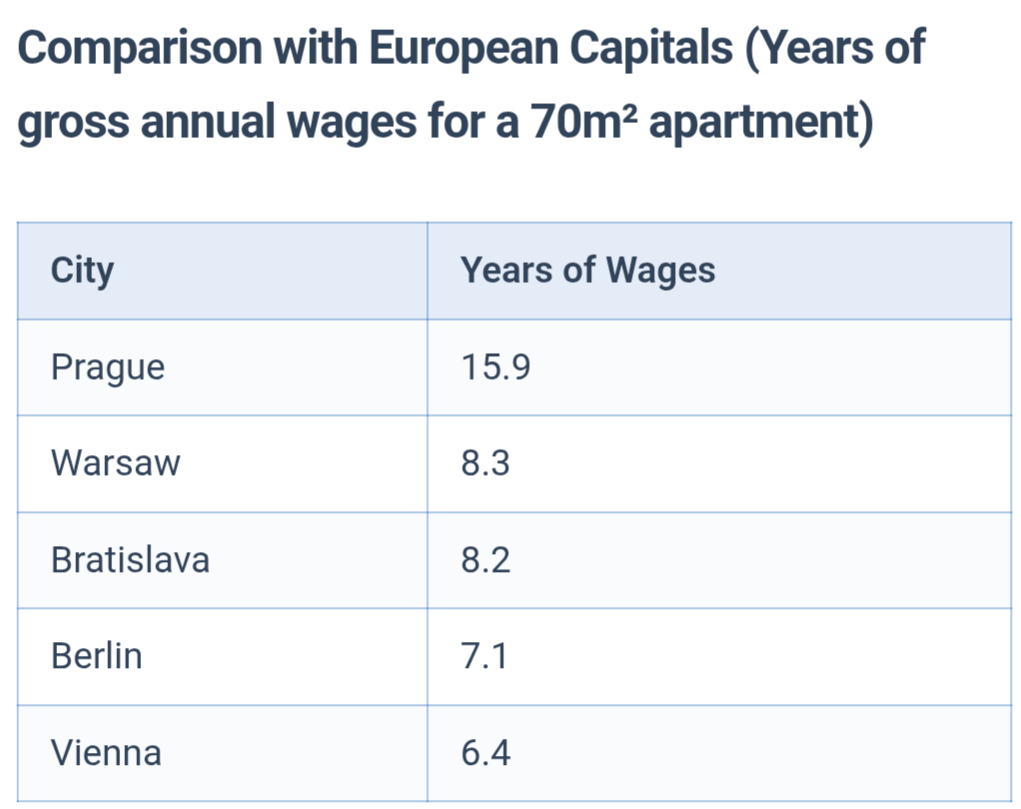
When we first began spending time in Czechia in 2021, I envisioned that a possibility would be to purchase an apartment in Prague to use while in town and then maybe rent out while elsewhere. For various reasons this is no longer realistic for me, including the huge price increases which continue every year. In fact, Prague is now the least affordable capital in this entire region for housing (and the third worst in all of Europe):
Housing affordability in Prague is worsening due to soaring prices, slow permitting, and inadequate supply. To purchase an average 70m² new apartment, a buyer needs 15.9 years of gross annual wages. This is a significant increase from a decade ago, when only 10 years of wages were needed. The city’s new apartment prices have risen by almost 180% over the last 10 years, while wages have only increased by just over 80%. This disparity has pushed Prague to the top of the list for the least affordable housing among Central European capitals. (Ref 1 – https://czechrealtor.cz/news/c4228b96-d834-48bd-95a7-a4079b368b51)
It’s not sustainable, clearly. I see loads of new apartment buildings under construction around the city, but apparently even these won’t be sufficient to compensate for the high demand.
For each stay in Prague I rent for 1-3 months, usually through a mid-term rental platform called Flatio where landlords offer furnished apartments, usually for stays of at least a month. Every time I rent the next apartment, the prices for apartments have increased since the previous visit. For October and into November this year I’ve rented a place the farthest outside of the city center I’ve ever stayed, so as to save money. It looks like a nice apartment, but really there’s not much nearby of interest, so I expect that I’ll be taking a lot of public transport during that stay.
This contrasts with my upcoming shorter-term rentals in Georgia, Armenia, and Slovakia where even for these short stays in the center of the action the costs average only about $40 per night in total. That would be $1200/month, and that includes all utilities. Cheaper than decent long-term options in Asheville and Prague. Imagine spending $40 total per night somewhere in the US for a hotel room — I wouldn’t want to stay there, haha!
I will definitely continue to relish time in Prague going forward because Sofia is here, because it’s an amazing place, and because I’ve established a fun social network. But I’ll also be eyeing other cities to visit around the world in 2027. Despite the inexpensive lagers, which I drink very few of nowadays anyway, Prague is no longer the “cheap” destination it used to be.
Speaking of money, Czech currency is called the crown, or koruna in Czech. There are about 21 crowns per US dollar with recent exchange rates, so each crown is worth about 5 cents. Czechia also officially uses the heller (haléř), which is 1/100th of a crown. But like the US penny, it’s no longer produced. I’ve never seen a heller outside of the Czech National Bank’s currency museum, as the coins were removed from circulation back in 2008.
The term heller (Czech: haléř, Slovak: halier) was also used for a coin valued at 1/100 of a koruna (crown) in the Czech Republic (Czech koruna) and Slovakia (Slovak koruna), as well as in former Czechoslovakia (Czechoslovak koruna). Only the currency of the Czech Republic continues to use hellers (haléře), although they survive only as a means of calculation — the Czech National Bank removed the coins themselves from circulation in 2008 and notionally replaced them with rounding to the next koruna.
https://en.wikipedia.org/wiki/Heller_(coin)
Did you know that the term “dollar” originated from here in Bohemia? There was a silver coin minted in Western Bohemia in the early 1500s called the Joachimsthaler.
And while Czechia currently uses the crown, the country is bound to adopt the euro per the convergence criteria after joining the European Union (EU) in 2004. They are probably technically ready, and there are some in the country’s leadership who are pushing for the change, such as the president, but it is not a popular concept for most citizens or politicians. Personally, not that I have a say, I wouldn’t want Czechia to adopt the euro because I’ve seen what happens in other countries that do so. Their prices increase markedly soon thereafter!
Today’s dad joke:
I prague-nosticate that Czechia will not adopt the euro within the next five years.
Today’s side story:
At the end of a recent group hike, we found ourselves in the smallish city of Děčín with over an hour to wait for the train to Prague. We were coincidentally standing in front of a cafe entrance, debating on how to spend that time. Some suggestions included finding a pub for beer, sitting in a park to chat, or just trying out the cafe since we were right there anyway. Looking at Google Maps, there didn’t appear to be many good options other than this highly-rated cafe. And I’m so glad that the consensus was to enter the cafe! It’s now my favorite cafe in the world, and their cappuccino was notably the best I’ve tasted in this country, much to my surprise. It’s difficult to get a true sense of how cool this place is online, but it’s got multiple layers, hallways, courtyards, and an outer shelter built into the side of a mountain. Check it out: it’s called Kytky pod komínem, and it was even featured in Forbes (Czech version).
But what was most memorable during our visit was that after about 30 minutes of our group sitting at a table drinking coffee and chatting, a guy hanging out with his partner at a table nearby leaned over and asked in English who was from the US. Everyone pointed at me, so I turned and said hello. He said they heard me say I was from Asheville. I confirmed, and he asked if that was in the Appalachian Mountains. When I acknowledged that, he asked if I knew about the “wendigos”. His Czech accent was strong, so I asked if he could repeat his question, because wendigo wasn’t a familiar term. I said no, and then he went on to describe what a wendigo is. I looked it up on Wikipedia, and remarked with surprise that he had taught me something new about my own country. He and his partner (girlfriend, wife?) said that they had never met someone from the US before! Amazing. I hope I made a decent impression, despite my lack of wendigo insight. I found it remarkable that this was the only topic about the US which he wanted to ask me about. That evening at my apartment I researched in more detail, and found that there was a video game from 2018 called Fallout 76, where wendigos are featured as one of the cryptid enemies in the area of Appalachia. So presumably he learned about wendigos and Appalachia from this video game! 😂
Wendigo is a mythological creature or evil spirit originating from Algonquian folklore. The concept of the wendigo has been widely used in literature and other works of art, such as social commentary and horror fiction. https://en.wikipedia.org/wiki/Wendigo
Today’s history video:
Prior to the fall of the Berlin wall, thousands of refugees from East Germany (GDR, or DDR) flooded to Prague to get to the embassy of West Germany to be granted permission to emigrate to West Germany. It’s an emotionally touching time:
Today’s Stoic quote:
“If you don’t know, ask. You will be a fool for the moment, but a wise man for the rest of your life.” ~ Seneca


I wasn’t familiar with the wendigo until now and also didn’t know about the dollar etymology! That got me going down a Wikipedia rabbit hole that ended at the “Hyperinflation in Zimbabwe” article. One highlight:
“Zimbabwe’s peak month of inflation is estimated at 79.6 billion percent month-on-month, 89.7 sextillion (8.97×10²²) percent year-on-year in mid-November 2008.”
Basically in line with the Prague housing price trajectory.
Incomprehensible! Anyone who used to be rich in Zimbabwe became a pauper overnight.