I was blown away by Baku, figuratively and literally, and it sometimes wasn’t good, and I don’t plan to ever return. Azerbaijan is ranked as the most corrupt country in Europe, and after being compelled to pay my first-ever bribe to a police officer, I would believe it.
But at the same time, I’m glad I visited, as Baku is a place of incredibly unique beauty, stunning architectural juxtapositions, compelling sights, and engaging history. And the stories continue to play out every day here. Tucked between giant historic aggressors Russia and Iran, it’s a conflict-rich region, and it’s frankly impressive that Azerbaijan exists as its own country today. That said, one tour guide told us that there are presently multiple times more ethnic Azerbaijanis in Iran than there are in Azerbaijan itself!

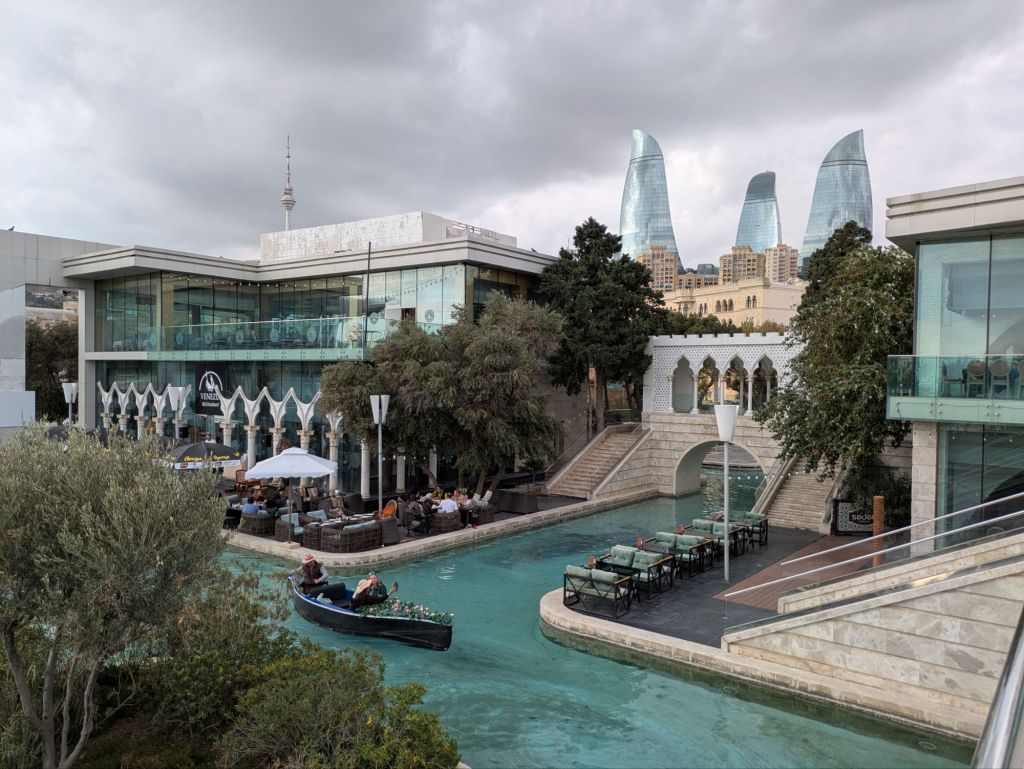
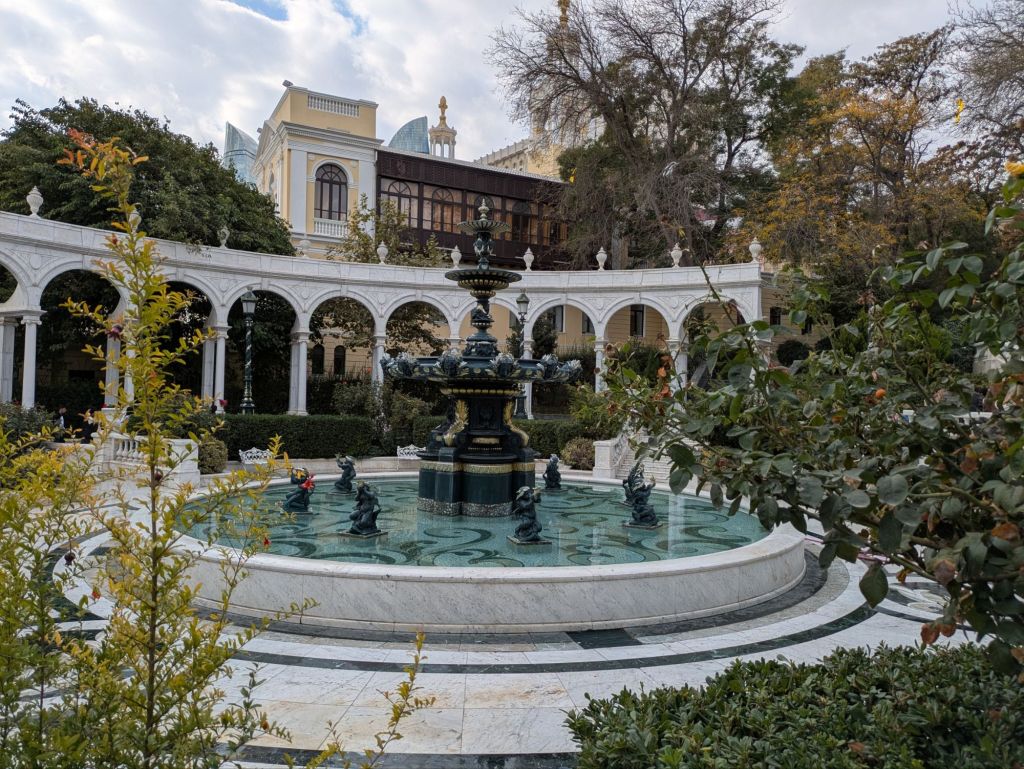
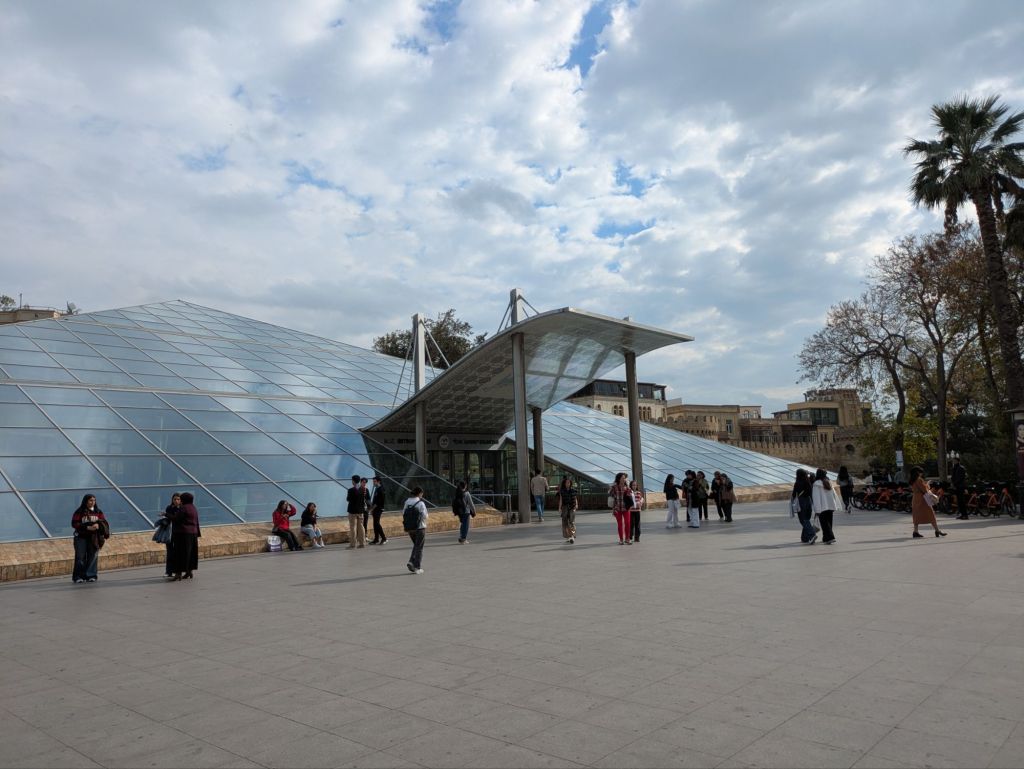
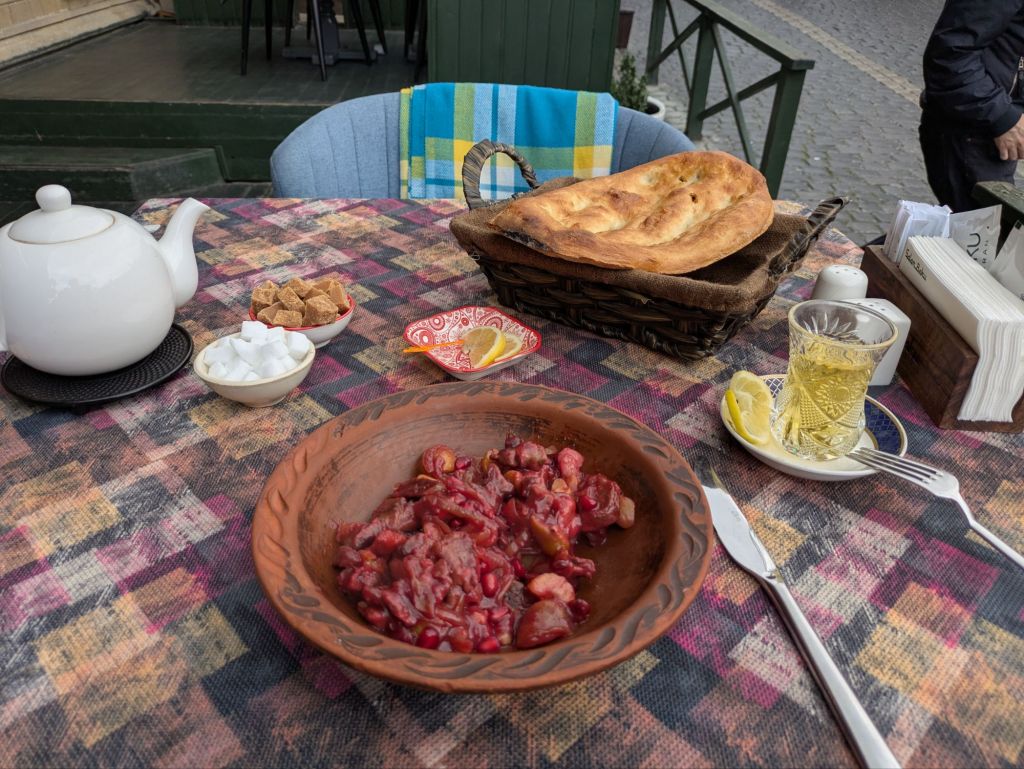
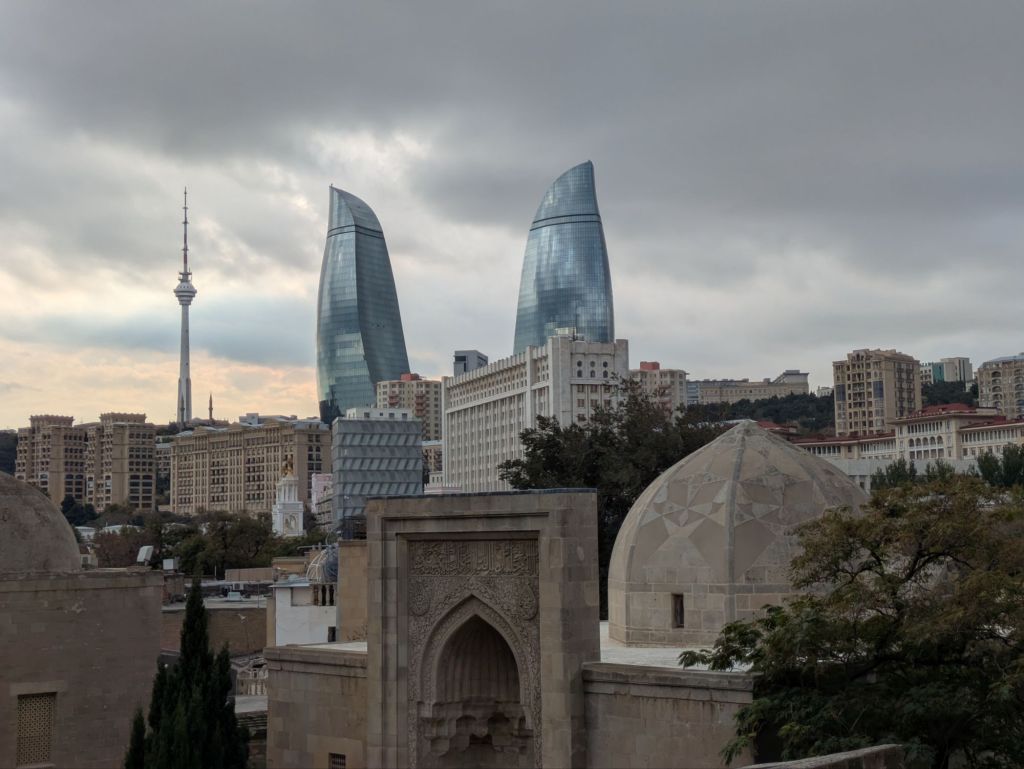
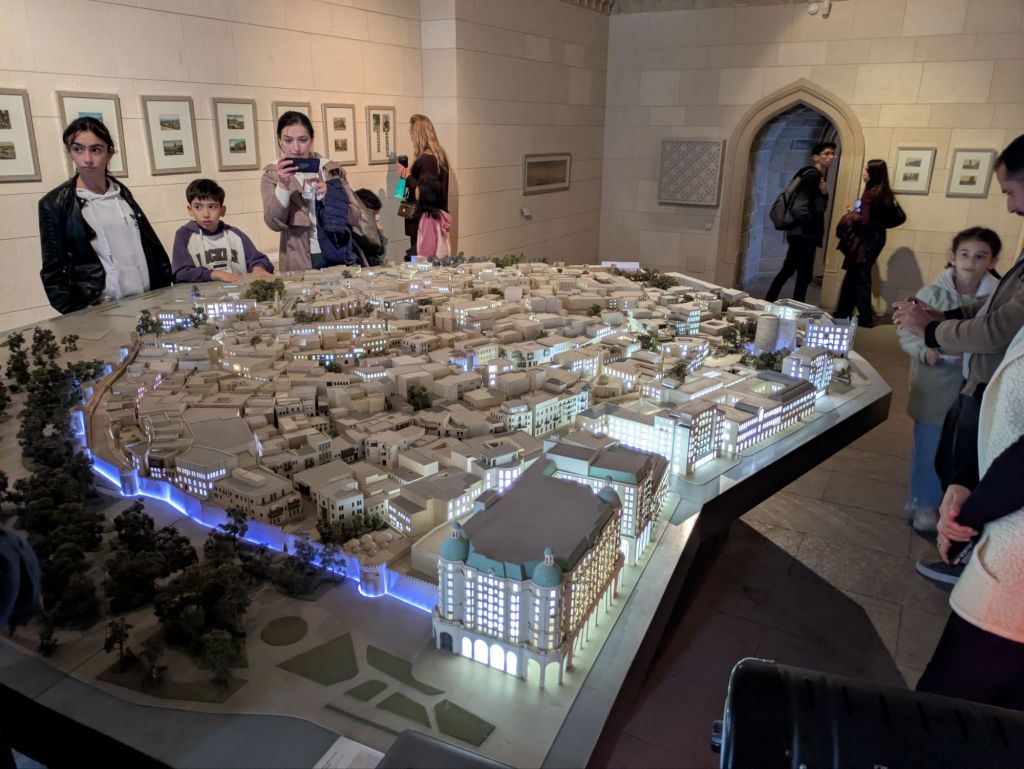
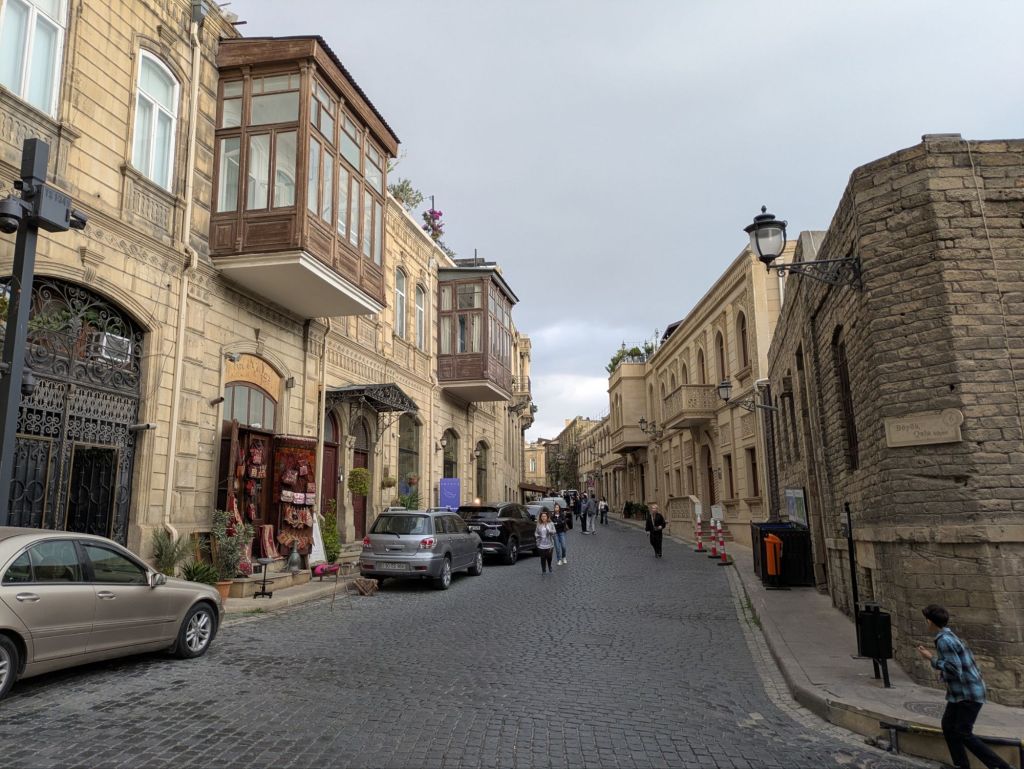
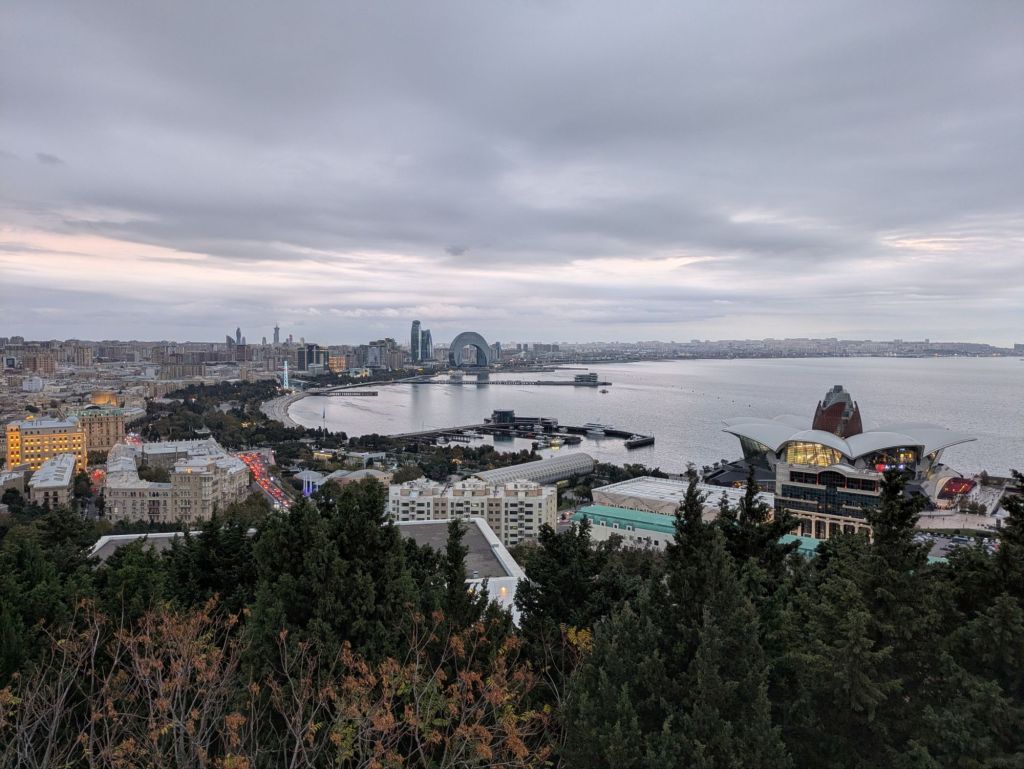
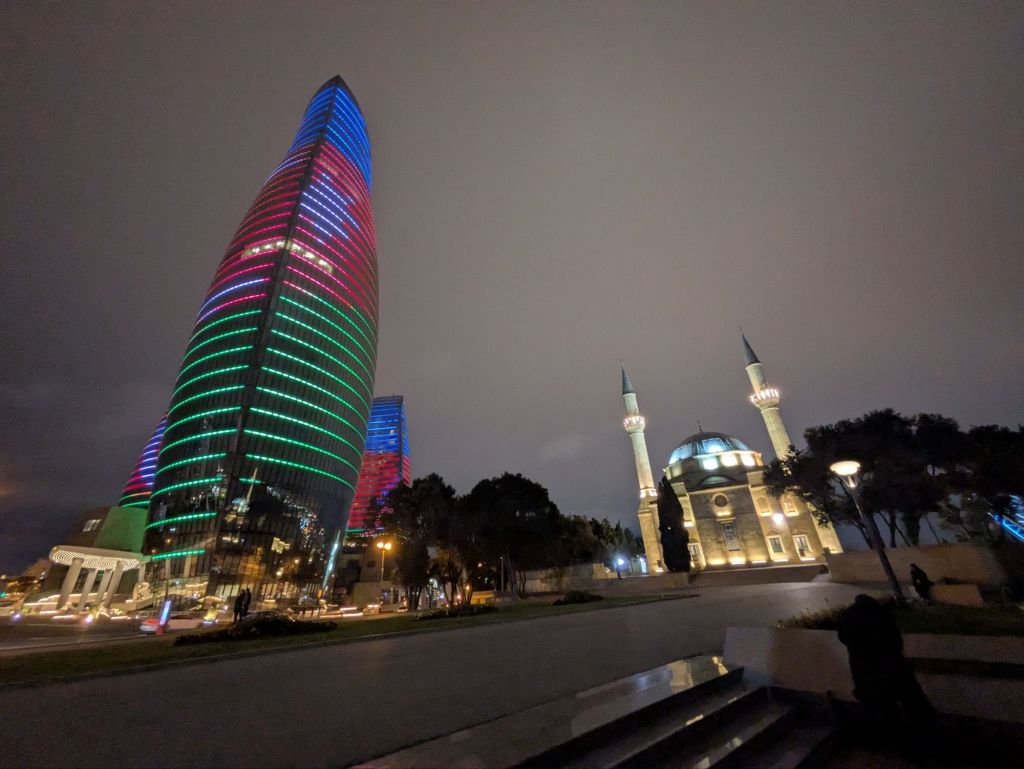
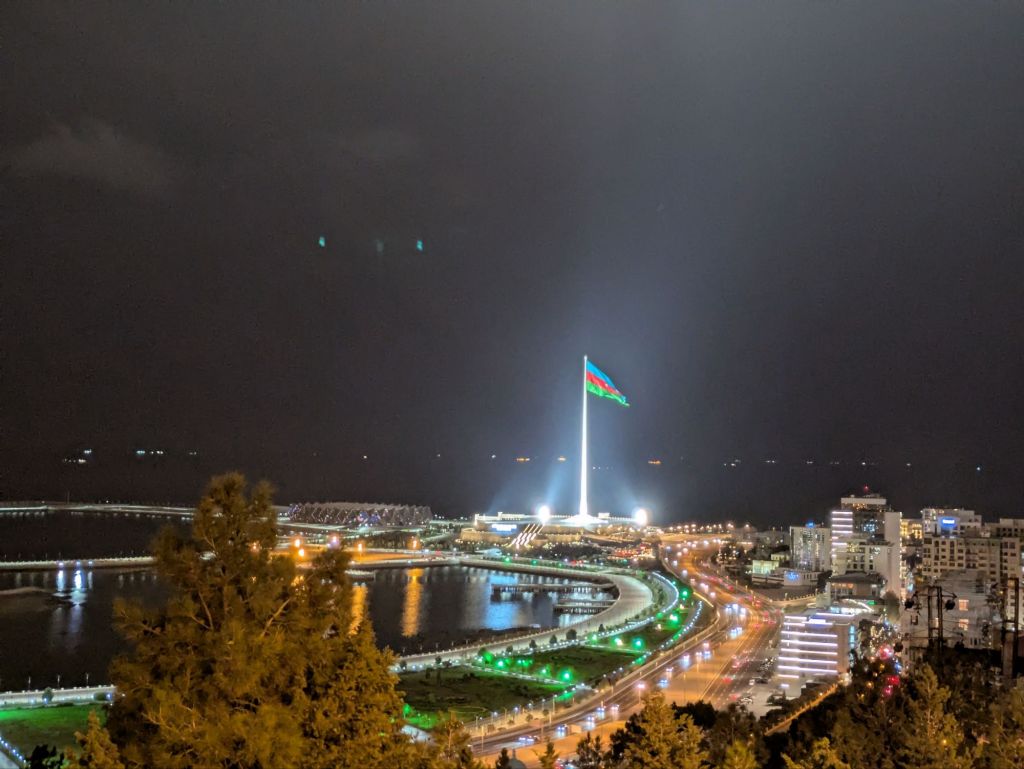
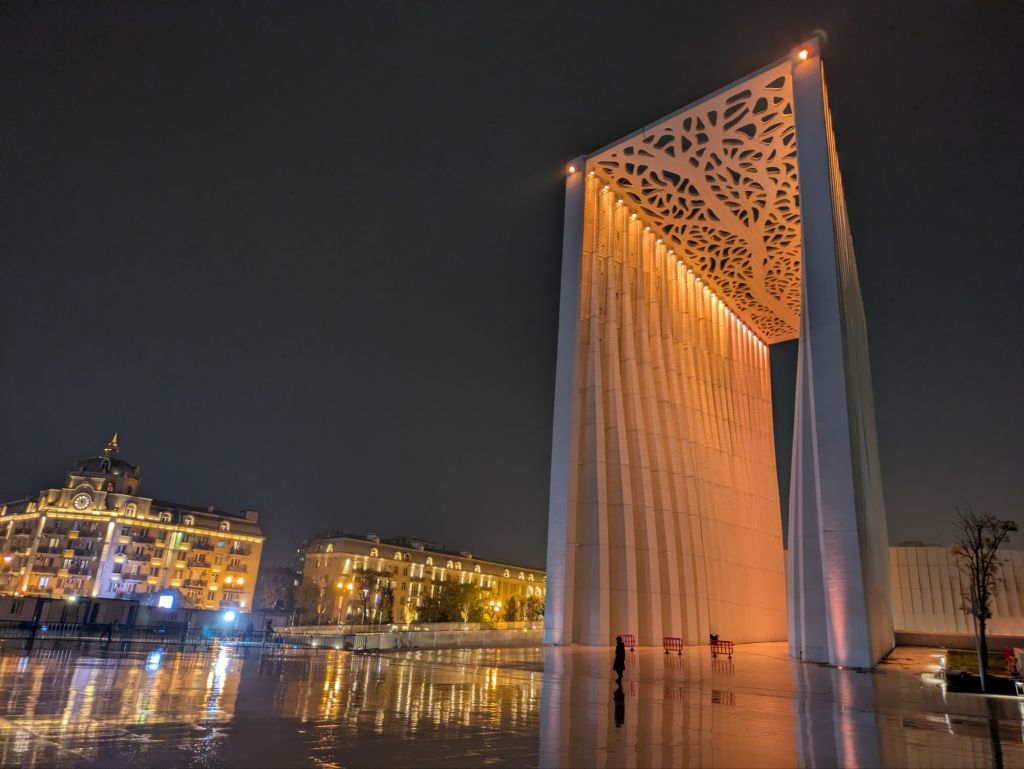
It’s a region spewing with fossil fuels, and Baku opened the world’s first commercial oil rig and was the world’s first oil exporter, with Azerbaijan supplying half of the world’s oil in the early 1900s! The extraction continues to today, making the country extremely wealthy. And overt signs of that wealth spring forth all over Baku, the capital and largest city. I took some excursions outside of the city, but only to other areas on the “beak” peninsula, so I don’t have experience in the rest of the country, which apparently is very diverse, full of natural beauty.

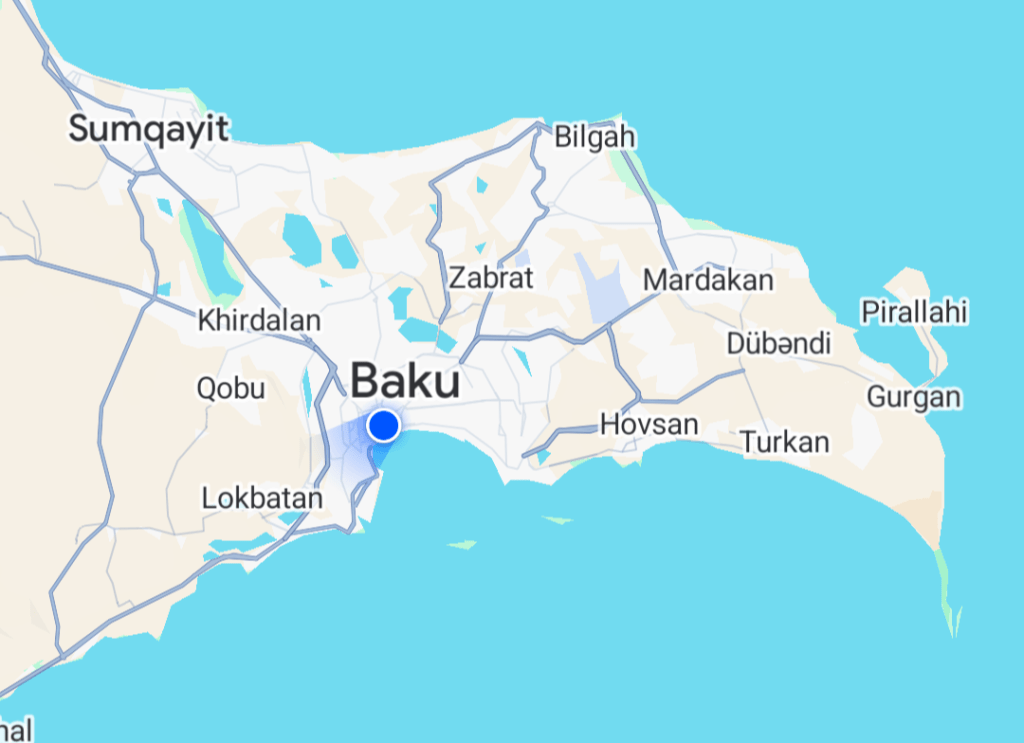
Baku is a place full of contrasts, with a simultaneously old and modern feel, a sort of Turkey meets Europe meets Iran vibe, with plenty of Russian influence and language still very evident. And despite being quite far east of even easternmost Turkey, Azerbaijan is often considered to be a European country. I read that English language proficiency in Azerbaijan was the lowest among European countries surveyed in a 2019 survey, but I didn’t have any trouble using my halting English. The majority of the Azerbaijani language overlaps with Turkish, and speakers of each can mostly understand each other. Russian was taught for years, and continues to be in use, and Azerbaijani itself was written using Cyrillic characters during Soviet times. Yes, Azerbaijan is yet another former Soviet republic. But after shedding the former overlords, Azerbaijan quickly changed to using Latin characters instead. Interestingly, further in the past Azerbaijani was written using Arabic script! How many languages can you think of which have used three different character sets? One tour guide told me that her parents still sometimes get confused using Latin characters instead of Cyrillic, over 30 years later.
So, speaking of Baku’s beak, and the connection to Turkey, another bird-related fact is that Baku has the world’s largest KFC! An additional surprise.
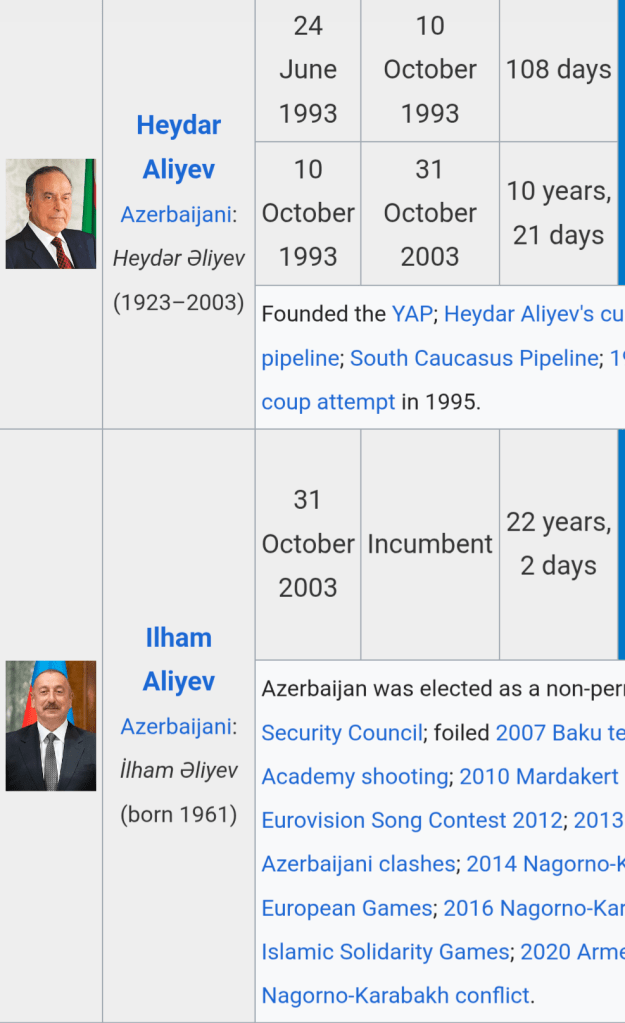
Corruption-wise, consider that the current president (Ilham Aliyev) celebrated 22 years as president (so far) in October of this year. And his father was president for over 10 years before that. And the current president’s vice president is also his wife, haha. Supposed democracy in action, but in the 2024 election Aliyev won with over 92% of the votes. Amazingly popular? His father certainly is now, by choice or not. The “Heydar Aliyev” name is seen everywhere – on the fancy airport, a cultural center, a palace, and many more. Difficult to get away from the guy. During one ride on a tour bus I saw a three-sided billboard with a giant photo of the current president on each side – no words, just his picture three times. That’s what democratically-elected folks do, right?
That said, much of the popularity is genuine. In such a volatile region of the world, many people like a strongman leader who will hopefully provide relative stability, despite some associated loss of democracy and human rights. And nowhere is that clearer than with respect to Armenia. The entire Caucasus region has long been rife with strife.
The complex jigsaw of warring kingdoms and khanates of the past has become a complex jigsaw of warring nation-states today, and remains sadly riven by three major conflicts: in Nagorno-Karabakh, South Ossetia and Abkhazia. In a tragic irony, these ethnic conflicts can all be directly traced to a policy of divide and rule used by Josef Stalin when he was the Soviet commissar of nationalities in the 1920s. When demarcating the region’s borders, Stalin purposely drew lines that would force the mixing of ethnic, linguistic and religious groups in an attempt to forestall any future nationalist movements, and presumably in the belief that the Soviet Union would never collapse. In 2023 the most intractable conflict of the three, that over Nagorno-Karabakh, suddenly flared up again after 30 years and saw Azerbaijan retake the region from Armenia. – Lonely Planet Georgia, Armenia & Azerbaijan
Readers of my recent blog post on Transnistria in Moldova will recall that there are two breakaway republics that do recognize Transnistria as an independent state. These are South Ossetia and Abkhazia. Nagorno-Karabakh is no longer a disputed region after the 2023 takeover and expulsion of Armenians, and so that associated flag has since been removed from the central square in Tiraspol, Transnistria.
My sense is that there is a lot of very deep animosity toward Armenia and Armenians here in Azerbaijan. There have been so many conflicts and thousands of deaths, and given the recency, the wounds are still raw. One tour guide told me that her husband cannot hear out of one ear due to an explosion that occurred during his military service fighting Armenian soldiers. But now Azerbaijan is the richest of the Caucasian countries, so its footing is much more solid. Of the Armenian Church of St Gregory the Illuminator in Baku:
This chilling symbol of ethnic division is a more effective representation of the tragedy of Nagorno-Karabakh than any monument or cemetery. Built in the 1860s, this church miraculously survived the Soviet era’s anti-religious campaigns and served Baku’s sizeable Armenian community until war broke out between Armenia and Azerbaijan over Karabakh in 1988. It’s now the only remaining Armenian structure to stand in the city, protected by the state to underscore its pledged commitment to tolerance, something that’s rather at odds with the fact that the building has been neglected and remains closed to the public. – Lonely Planet Georgia, Armenia & Azerbaijan
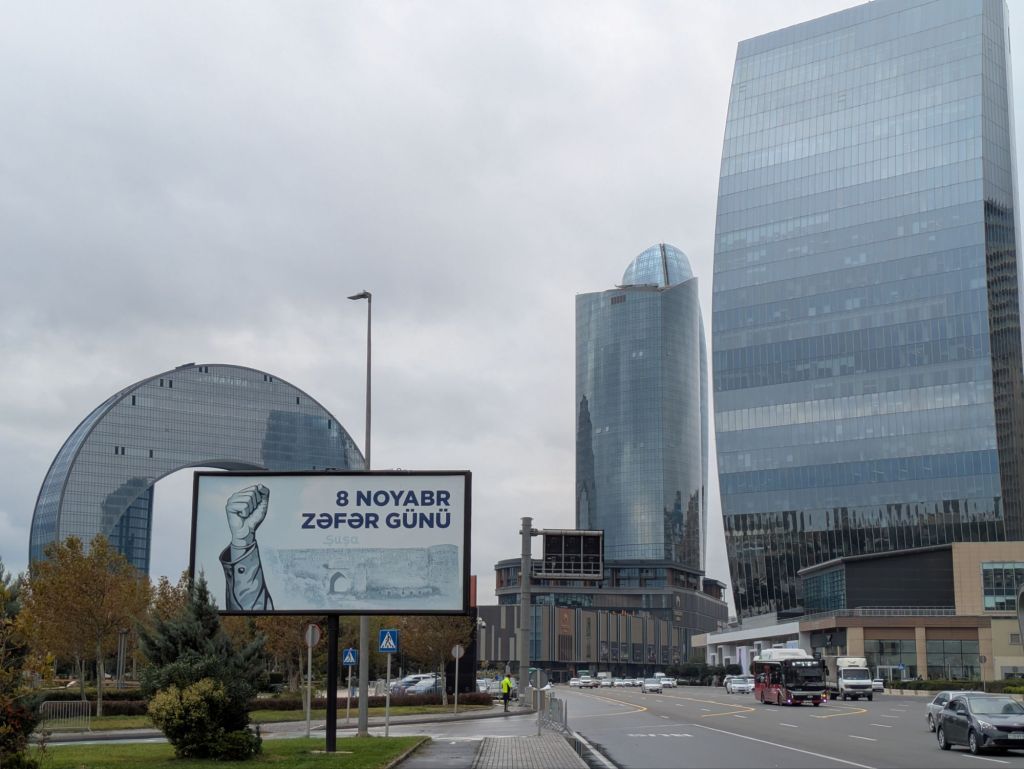
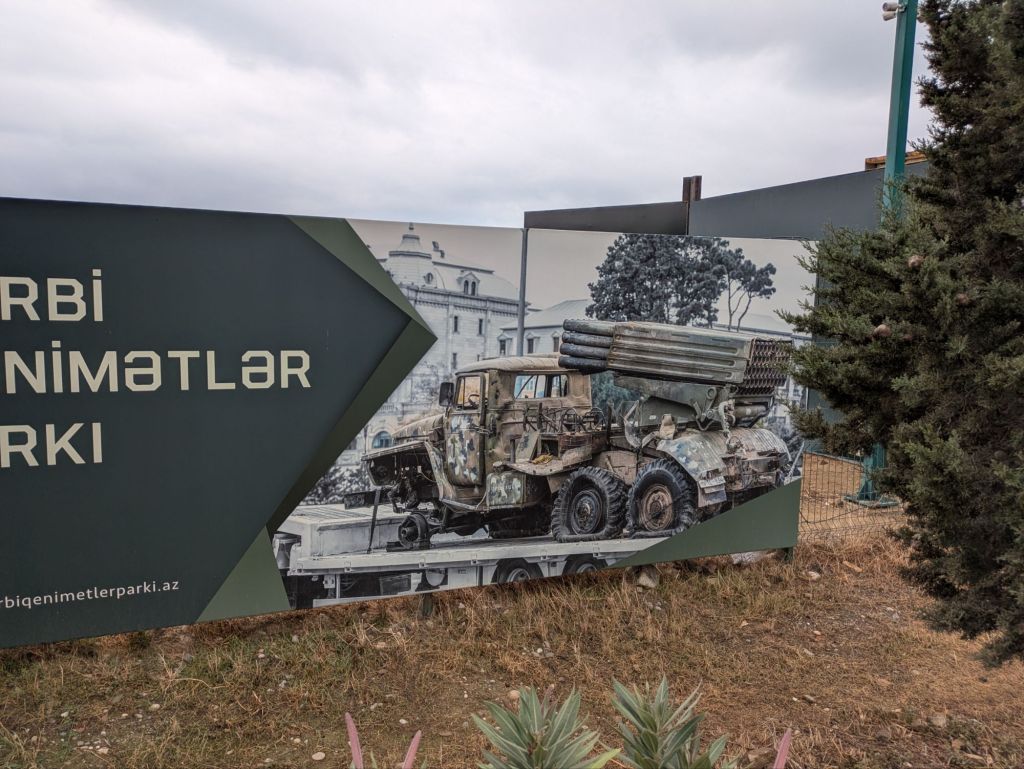
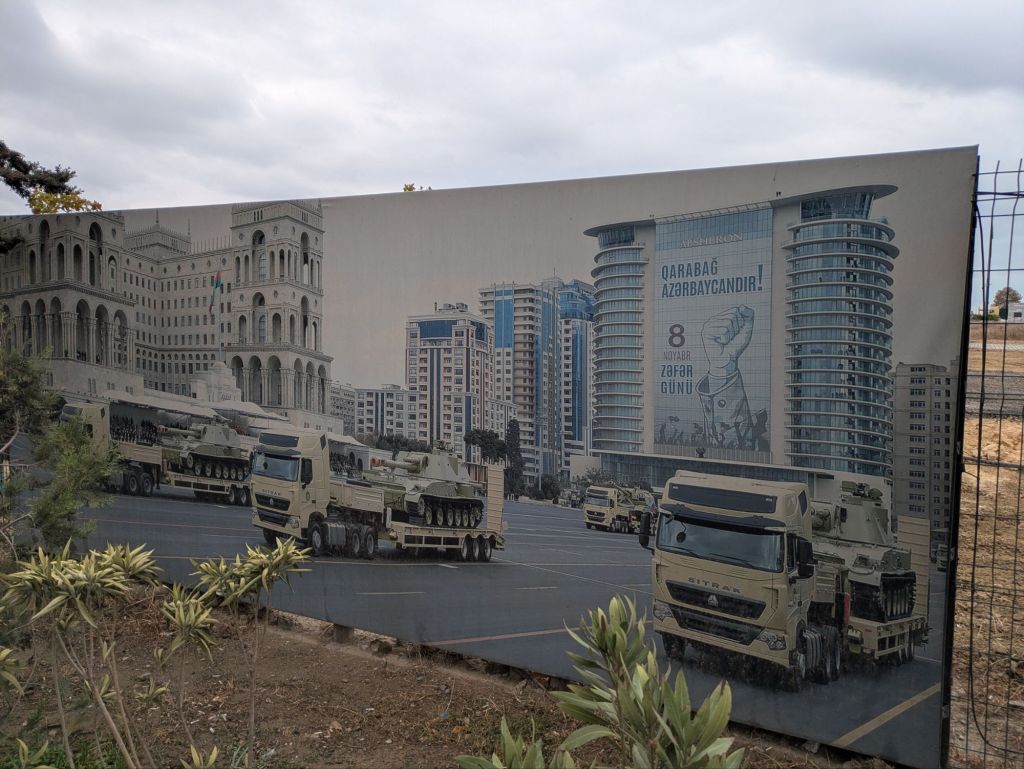
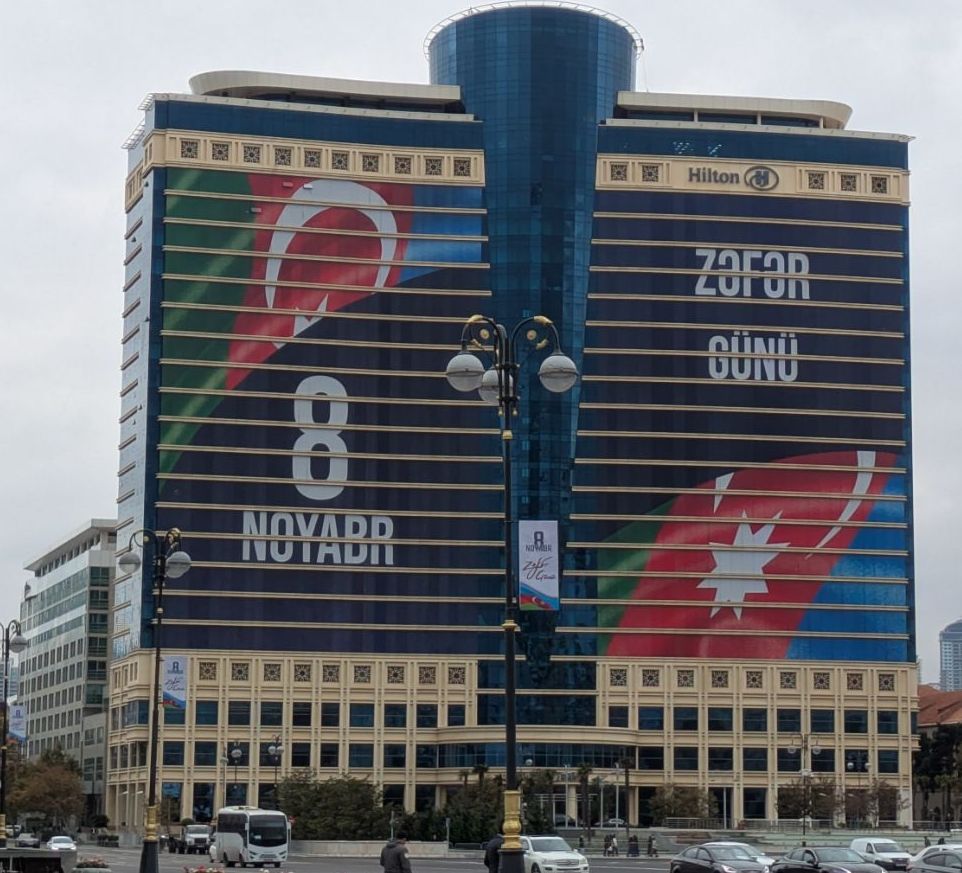
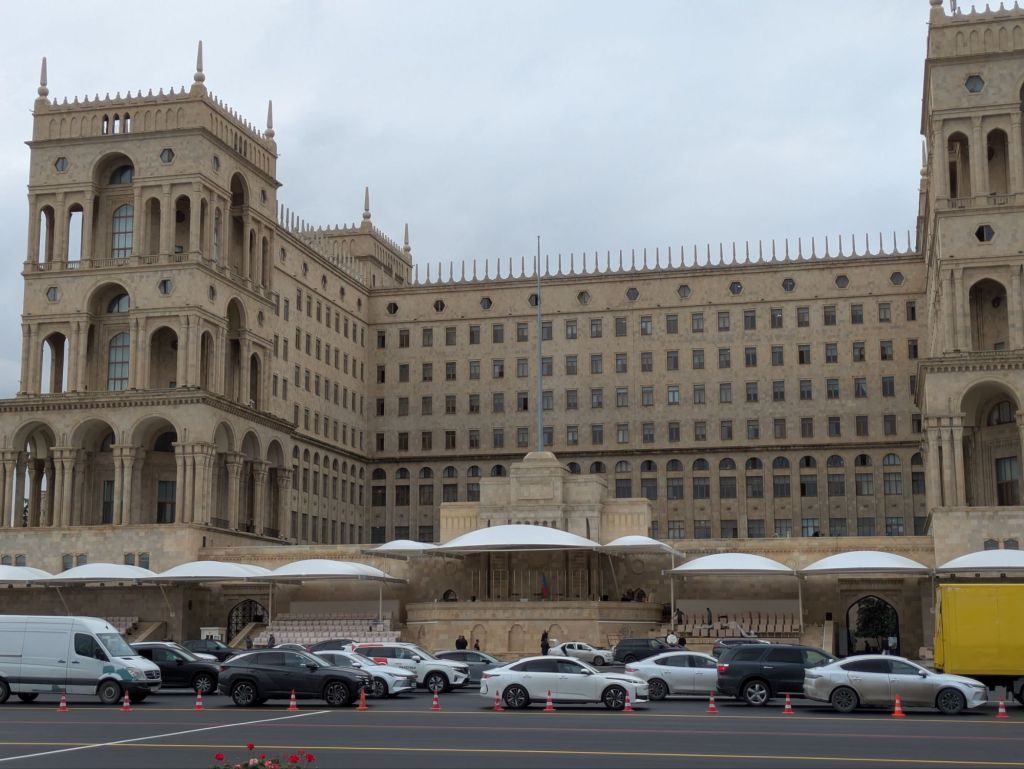
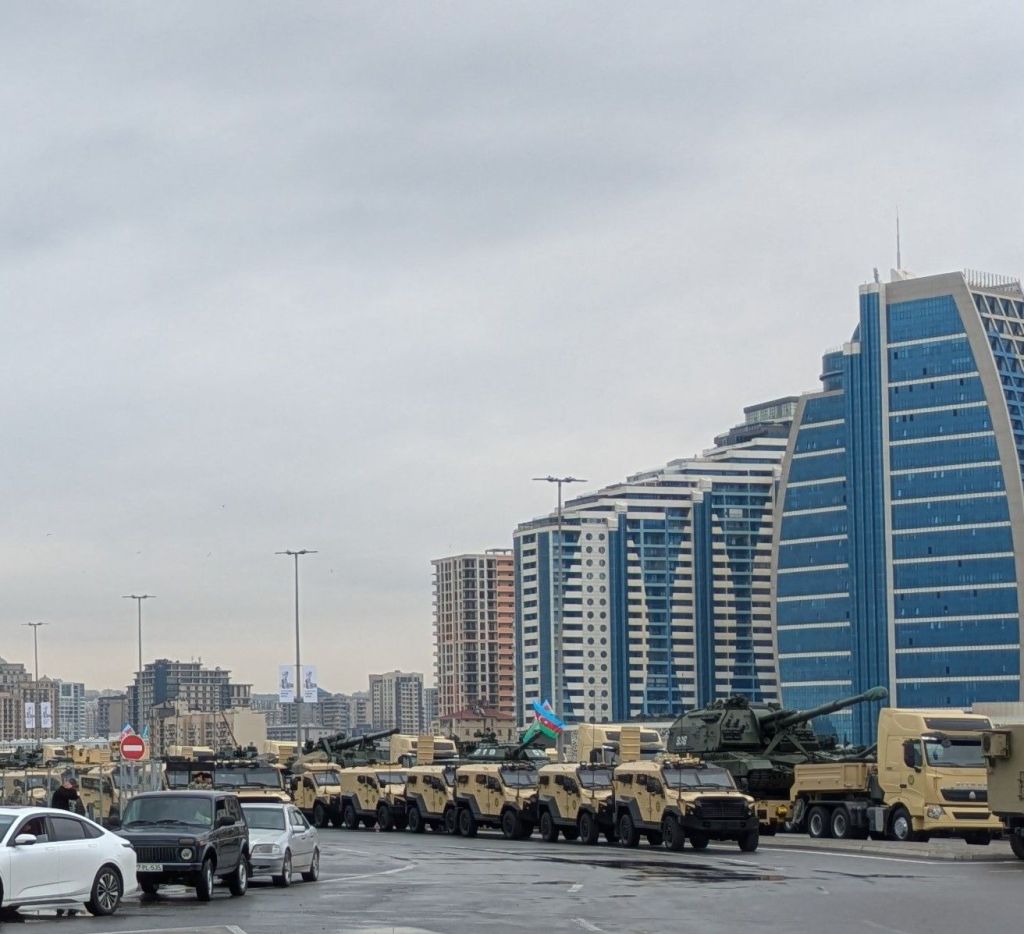
This tension is palpable, and Nov 8 is a public holiday currently advertised (in the days leading up to this Victory Day) on government building banners with a logo of the president’s fist, commemorating Azerbaijan’s victory in the Second Nagorno-Karabakh War with Armenia. There’s also a War Remnants Park, or as the Azerbaijanis seem to prefer to refer to it, a war “trophies” park, with a huge outdoor collection of Armenian military apparati damaged or destroyed during the various conflicts between the countries. I tried to visit during my stay, but the only way in was from a road which was blocked off, as it was lined on both sides and in the middle with seemingly endless rows of modern Azerbaijani tanks, missile launchers, and various other military vehicles. These were presumably collecting on November 4 (the day of the photos) in preparation for the weekend’s planned giant November 8 military parade. Using Maps, I measured that there were 3 kilometers (almost 2 miles) of these vehicles lined up! And there were three rows, so that’s 9 kilometers total of vehicles! As far as the eye could see.

Add to that the ubiquitous police presence and the surveillance cameras everywhere, and it can feel suffocatingly tense and constrained. And after personally being stopped by the police, thereafter I also felt a bit paranoid. Once when rushing to get between the termination spot of a daytime walking tour to the starting point of a nighttime van tour, I cruised down a long set of steps from the city viewing platform. When I reached the bottom, I came to a sort of ad hoc parking lot and a road. There was some traffic on the road, but not much, and I needed to get to the other side to continue my descent down the hillside. I’ve been traveling a lot to Balkans countries in recent years, such as Bosnia, Albania, and Romania (all the countries ending in “nia”, apparently), and crossing roads without crosswalks is what one does there, so I’m quite used to it. But I forgot myself for a moment, because I wasn’t in the Balkans anymore, but in the Caucasus region in an authoritarian country. As soon as I reached the other side of the road, a policeman approached me. I realized immediately that I was in trouble for jaywalking. He said something that I of course didn’t understand, so he pointed back to where I had come from, and then pointed farther down the road where there was a crosswalk, saying what I interpreted to mean that I should have crossed there (even though my reckoning had been that crossing the ad hoc parking lot to get to the crosswalk would have been more dangerous to me). I thought I was going to get a ticket and a fine, so I waited as he typed something on his phone. But he was just translating from Azerbaijani to show me the translation into English that in order to leave I had to first pay him 50 manat, which is almost 30 dollars. At that point I figured I could try to argue, but frankly having more police there instead of just him didn’t actually seem like a good option. And even if I did somehow manage to convince everyone that I didn’t deserve to be penalized, that might take hours, and then I’d miss my next tour anyway. Plus, escalation could lead to jail or worse, so what choice did I really have? So I pulled out my wallet, having just recently gotten out some manat from an ATM (which ironically did not charge any fees), and tried to count out the right amount of money. Only after I struggled for a while did he indicate that “just” 40 manat would suffice, at which point I realized that I could have negotiated because this wasn’t an official fine, but an off-the-record bribe. Oh well, it’s a decent story. As a side note, while I was in Chisinau, Moldova, a new Czech acquaintance told me of his time when he was younger traveling across eastern European borders where he and his friends would bring packs of cigarettes and US $1 bills to bribe the border guards to be allowed across. He said there wasn’t just one crossing, but that there were normally multiple checkpoints at which each set of guards needed their “payments”. I’m not a fan of places like this or like that.
Here’s another video from the Swedes at Yes Theory, this time with their experience visiting Baku and the Azerbaijani countryside. It’s a mixed bag, as you can see. The average person here can be quite considerate and very kind, despite the overarching pressures:
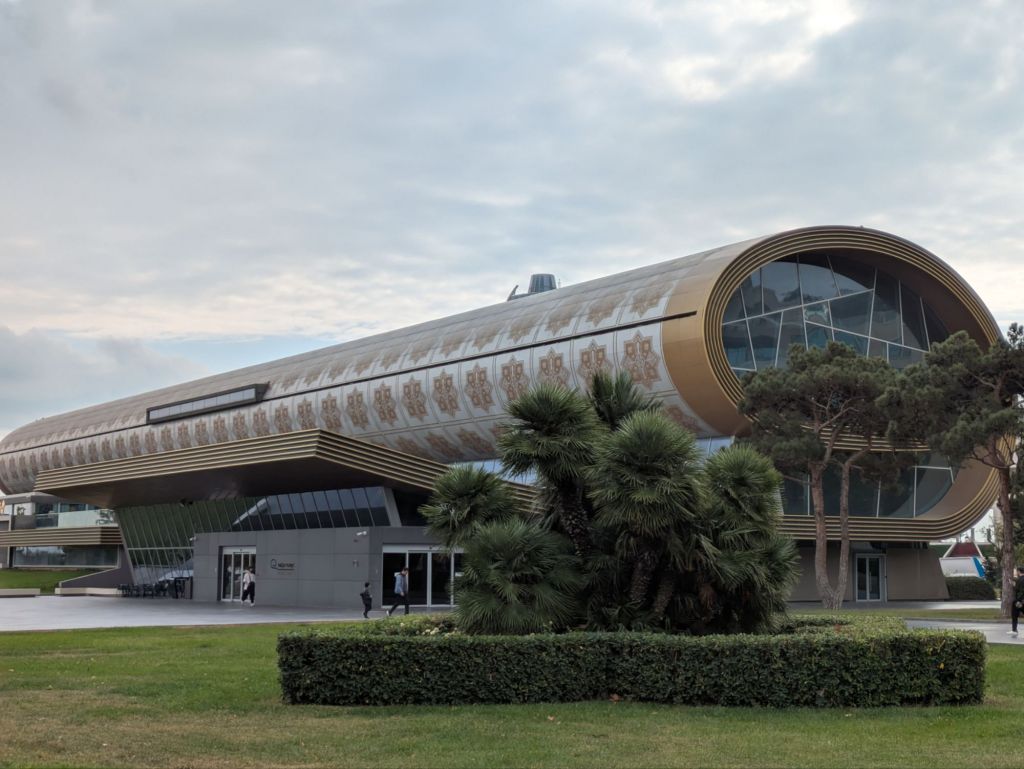
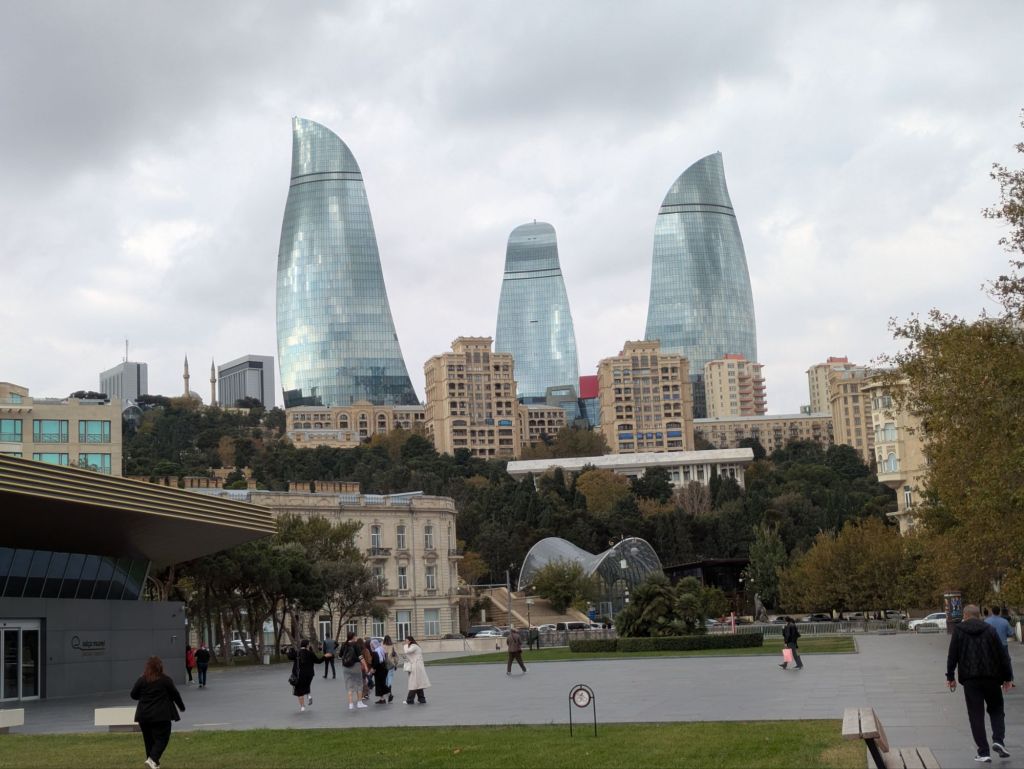
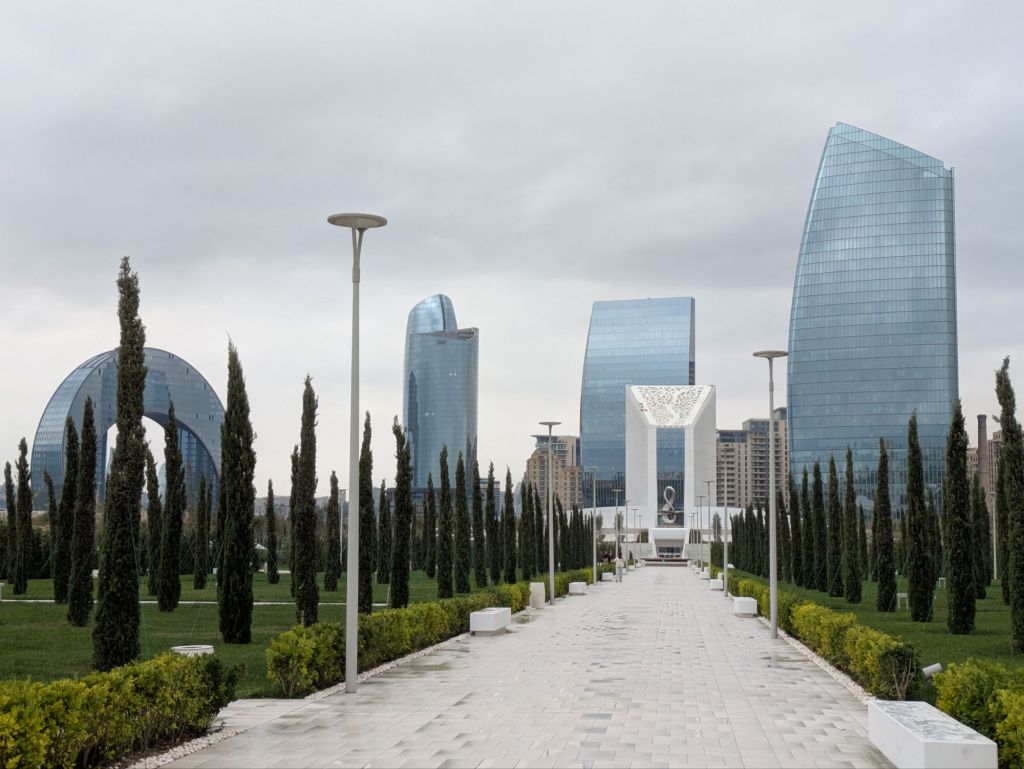
On a more positive note, there is much to see and do in and around Baku. One could easily spend a week here and not run out of things to experience and observe. Highlights include the old town, the Flame Towers, Martyrs’ Lane, Palace of the Shirvanshahs, the funicular, the Azerbaijan Carpet Museum, the waterfront Baku Promenade, Maiden Tower, and Heydar Aliyev Center. But really, it’s hard to beat just walking around and witnessing the crazy views.
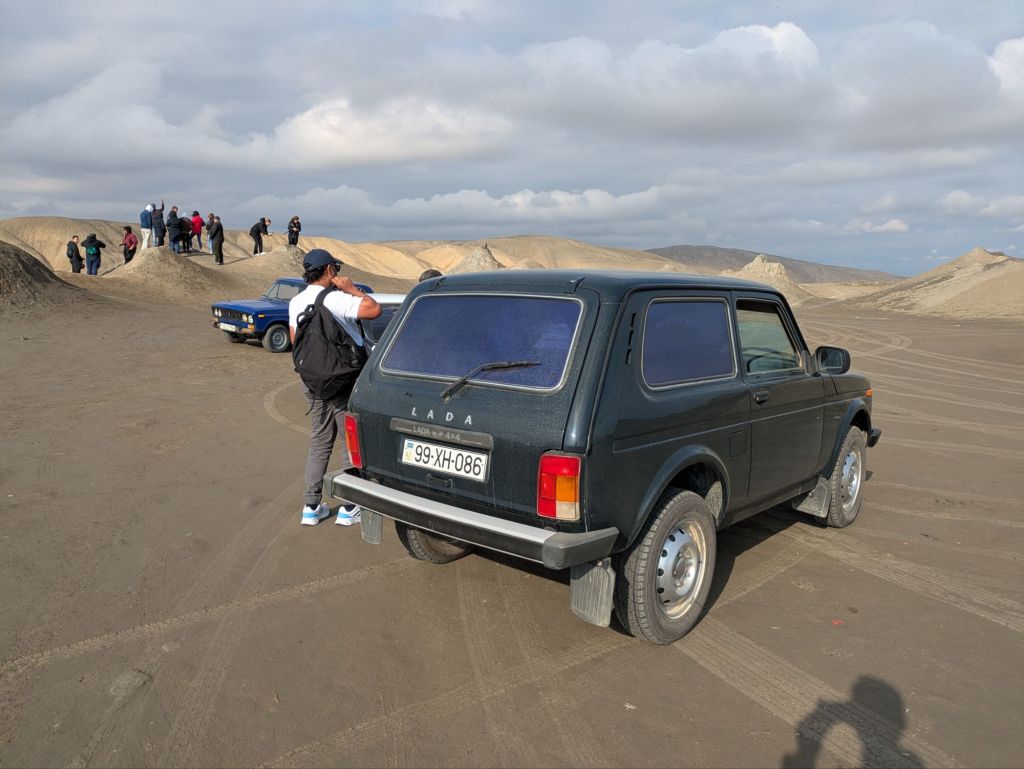
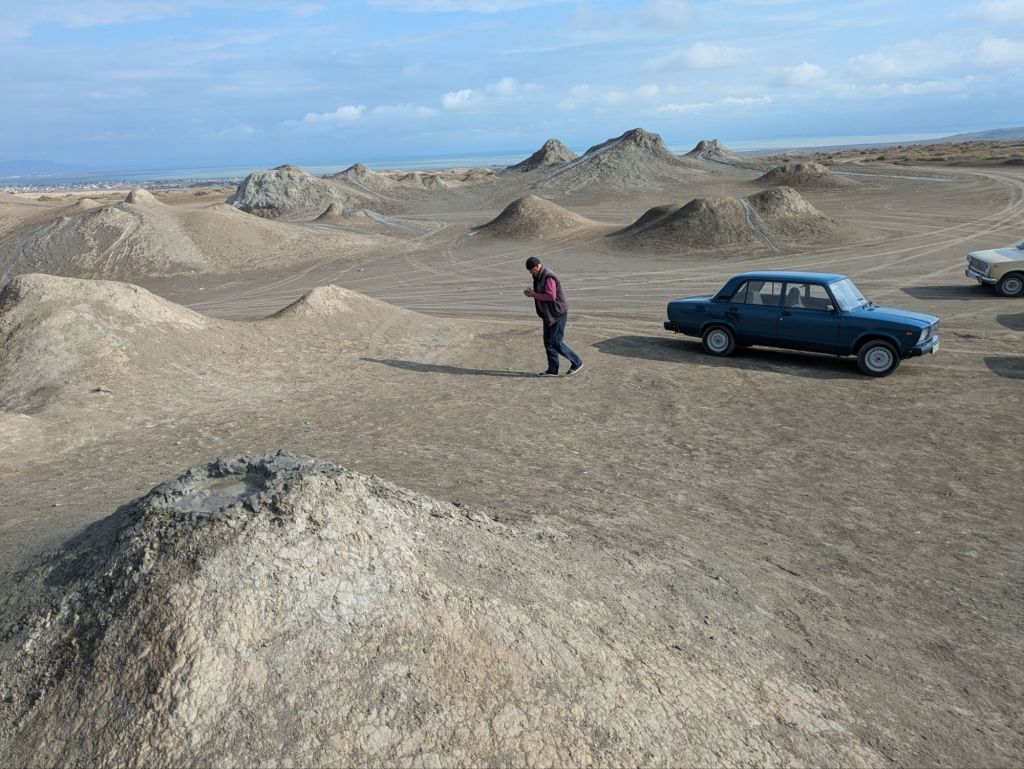
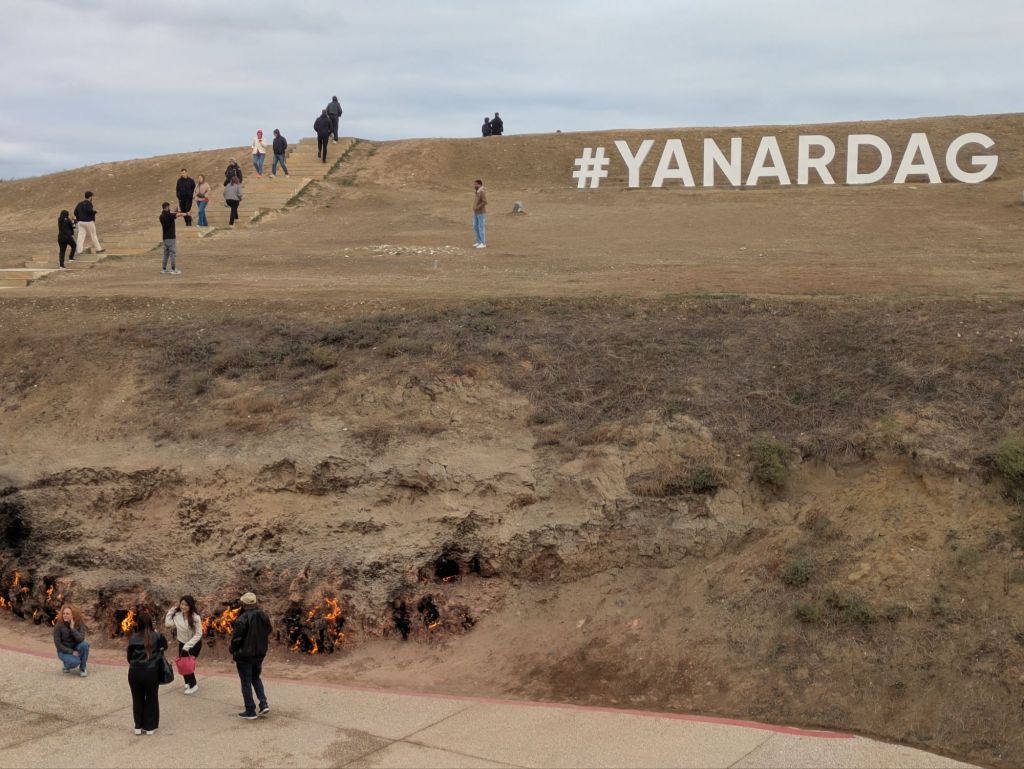
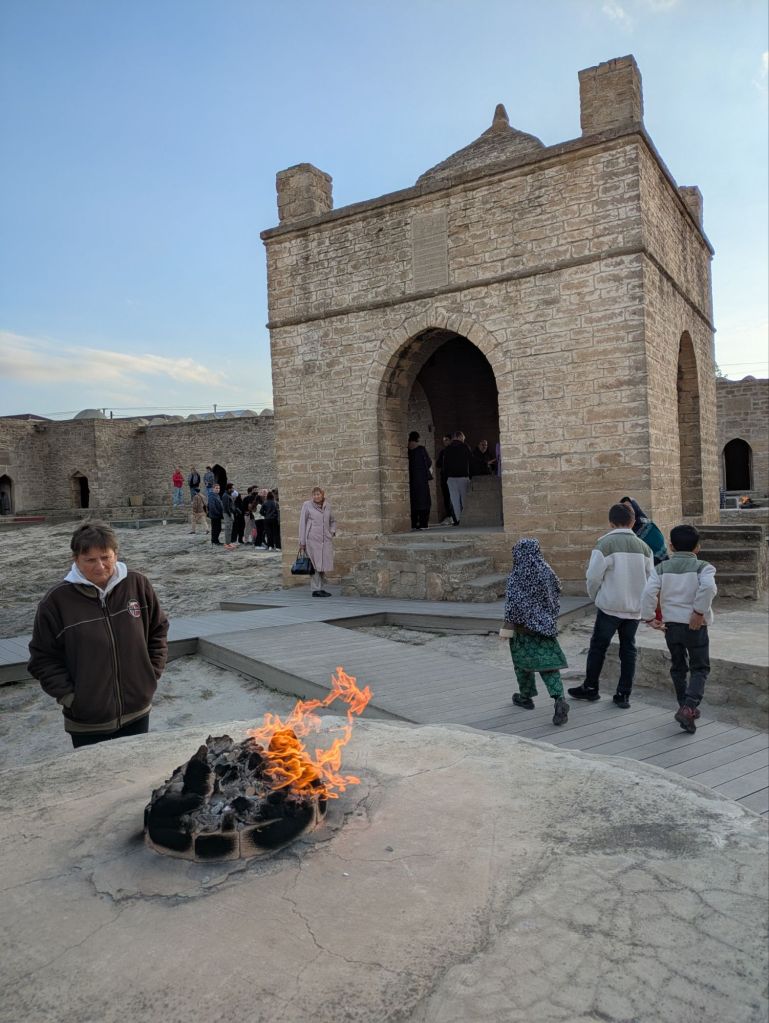
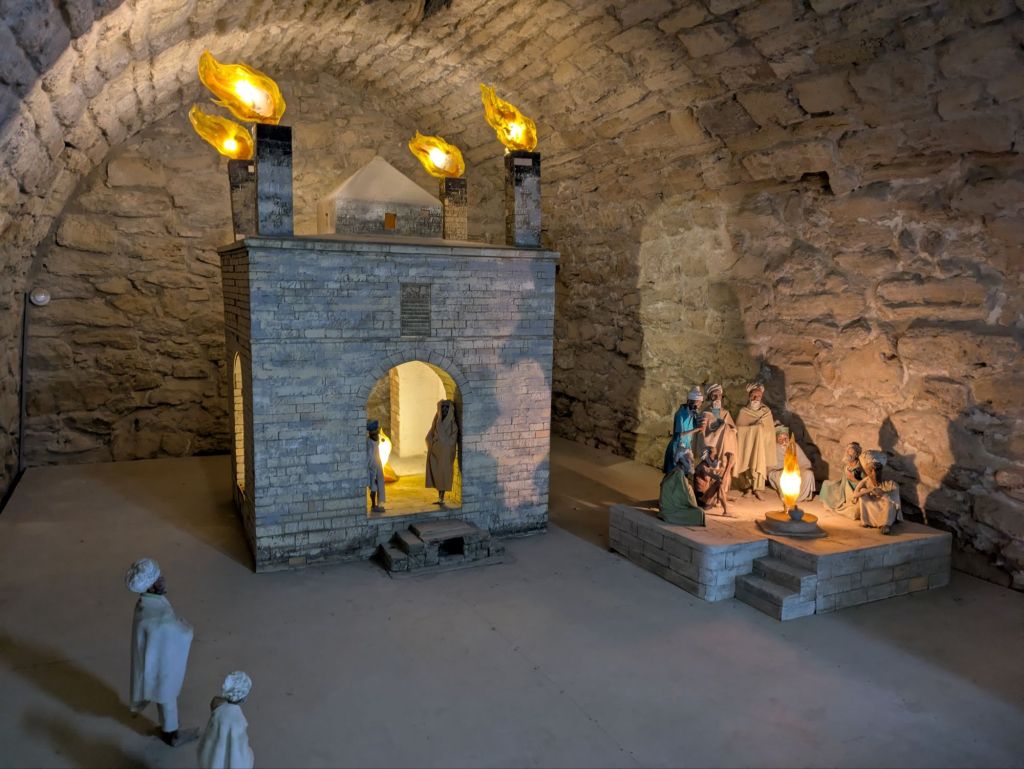
And the peninsula around Baku holds hundreds of mud volcanoes, fire continuously shooting out of a hill, an old Zoroastrian fire temple, and 12,000-year-old petroglyphs carved by long-ago ancestors. To get to the mud volcanoes, we had to cram into a creaky, old, gas-stinking Lada and speed over a hilly and rocky terrain, avoiding potholes and oncoming fellow Ladas and other vehicles over blind hills. Flammable outputs are seemingly omnipresent around here, and the flames baffled peoples from past millennia, understandably leading to lots of fire worship. It can also be very windy on this peninsula, and wind and fire are not a great combination. Baku is known as the city of winds.
Another fascinating nearby man-made feature, but one I didn’t visit, is the Neft Daşları, a giant offshore platforms network, which is also the world’s oldest offshore oil platform, created during Soviet times. This “city on the sea” had 5000 residents at its peak, with over 200-300 km (120-180 miles) of connecting bridges.
The Caspian, on which Neft Daşları is perched along with countless other rigs, is technically not a sea because it has no outlet to an ocean. So the Caspian is actually one big inland lake. Baku is the lowest-lying capital city in the world, at 28 meters (92 feet) below sea level! And it’s obviously higher than the Caspian itself. And like its central Asian neighbor, the Aral Sea, the Caspian has been shrinking at an alarmingly rapid rate. Man-made causes such as damming on the Volga River, paired with the strong winds and low rainfall are quickly drying up this huge body of water. Water levels have already dropped 2 meters (6.5 feet) in just the past twenty years, and could drop another 10-18 meters (33-59 feet) by the end of the century, if not more! Depending upon preexisting water levels, this drop impacts different shorelines more extremely than others. The coast could shift by up to 50 kilometers (30 miles) in some areas! From the above article: “Twenty years ago, the coast was just two kilometres from his home, but today it’s more than 20 kilometres away. The sea is now at the end of a sandy track that crosses an arid, flat steppe.” The designation of the Caspian as a “sea” or a “lake” determines how its resources (oil, gas, and fisheries) and territorial waters are divided among the five surrounding states of Azerbaijan, Iran, Kazakhstan, Russia, and Turkmenistan. Everyone except Iran wins if it’s considered a sea, and then vice versa if it’s designated as a lake. Surprisingly, there was a convention on the legal status in 2018, and the result was a hybrid sort of neither-nor designation compromise.
Like tourists from most other countries, before arriving I had to obtain an electronic visa (“e-visa”) which I then had to print and bring along for passport control (thus negating the electronic aspect, haha). Nationals of the following countries don’t require a visa: Belarus, Georgia, Kazakhstan, Kyrgyzstan, Moldova, Russia, Uzbekistan, Ukraine, and Tajikistan. I believe the cost to apply was $26, so it’s a decent source of revenue for the government. I encountered quite a different mix of tourists than experienced in all the various European destinations I’ve visited over the past few years. There are many regional visitors, along with loads of Indians. Not so many Europeans or Americans. When I was recently in Transnistria in Moldova, where Russian is the main language in use, I found it interesting to see how many common Russian words I could read now that I’ve learned some Czech. And when on tours in Baku, it was fun to hear how visitors were comparing common cognate words between Azerbaijani and Hindi or Arabic, or even Persian. I hadn’t realized that there was such a linguistic overlap in this region, but it makes sense. I mentioned earlier that Azerbaijani used a Latin character set, but there are certainly some extra characters which languages like English don’t have, and I particularly like the upside-down “e”: ə. I understand that it sounds rather like the “a” in English “cat”.
While in Baku I sometimes, but not always, found Google Maps to be inaccurate, in some cases remarkably so. I read that several independent observers have reported GPS anomalies in and around Baku Bay, including signals showing ships miles inland or at the airport. There may be some low-level GPS spoofing or interference, which some analysts believe may be used to protect sensitive sites (government buildings, oil infrastructure, or the Presidential Palace). I could not find that such signal manipulation is officially confirmed, but I read of similar issues having been documented in cities like Moscow, St. Petersburg, and Tehran. Sometimes destinations like restaurants were on the opposite side of the street than where their respective pins showed on Maps, and in one case I never could find a popular coffee shop anywhere within a block in every direction of where it was reported to be on Maps!
Today’s funny sign:
As seen in a hotel in Prague. I’m continually impressed by the funny signs in English in Europe.


 Major Meander
Fascinating post. I’m surprised that you didn’t say that you’ve increased your Azerbaijani proficiency so that you can now order off a local menu after spending a few hours picking up Cyrillic script and Russian. Also, smart how you made a “business decision” and paid the bribe. Good story for your future grandkids!
Haha, yes, paying the bribe seemed to be the prudent thing to do. Even in the moment I was thinking about how it’ll make a good story. The weird and “bad” things are often more interesting anyway. 😉