
Now that I’ve been back in the US for almost two months, I have confirmed that I do indeed enjoy dividing my time between Asheville and Prague, with each offering various highlights and advantages. Why choose just one?? It’s the best of both worlds.
I admittedly at times feel a bit discombobulated from living two very distinct lives in two markedly different places. But I’m deeply grateful for the time I’ve had back in NC and Virginia with family and friends, and I’m also excited for all the various fun events I’ve got planned in Prague after my return in early September.
However, I also have a long to-do list for integrating myself better in Czechia, not only for legal requirements, but also for ease of living and logistics. I obtained a Czech visa in June, and it’s a 12-month long-term visa which lasts through the end of May 2026. It’s this visa that allows me to travel to and stay in Czechia as much as I want through May of next year. The time in Czechia does not count against the maximum time allowed in the Schengen Area, which is a collection of most European countries, where they allow tourists to stay for up to 90 days in any 180-day window. So this also means that I can (and will) use Czechia as a convenient base for other European travel, and the time in Prague won’t count against me.
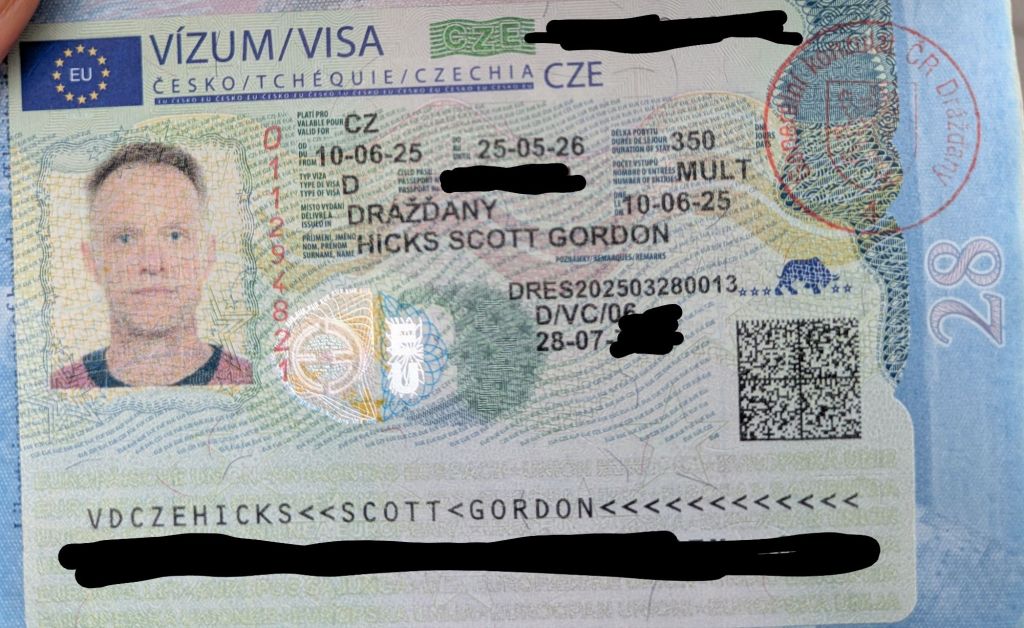
Obtaining the Czech visa was a somewhat time-consuming and bureaucratic process, as I’m sure you would have guessed. But it wasn’t that difficult or long because I recruited expert assistance from a visa agent to guide me along the way, though there were some hiccups during the journey. In the end I sincerely doubt I could have done it without her! I got the long-term visa through the fast-track digital nomad program. Citizens of a short list of non-EU countries, such as the US, the UK, Japan, Mexico, Brazil, India, Israel, Taiwan, Singapore, South Korea, Canada, Australia, and New Zealand are eligible for consideration. Additionally, one must work in information technology (IT) or marketing outside of the Czech Republic, and must make at least a specified minimum monthly income to be eligible. A worker can be employed for a foreign company or can be a freelancer (like me). I was required to obtain an affidavit from one of my clients, affirming that they have a contract with me for at least one year whereby I’ll be providing them with “IT services” (the definition is nebulous enough so as to allow for broad interpretation) with a certain compensation rate (sufficient to meet the program requirements).
As part of the process I was also required to complete many forms and to submit documents like an FBI criminal background check report and a bank statement showing I had funds of at least the required minimum. Everything had to be in Czech or translated into Czech with lots of certification and notarization. Czech government workers love paperwork, and they really love their official stamps! My agent also recommended that I include my Master’s degree certificate to show that I was educated in IT.
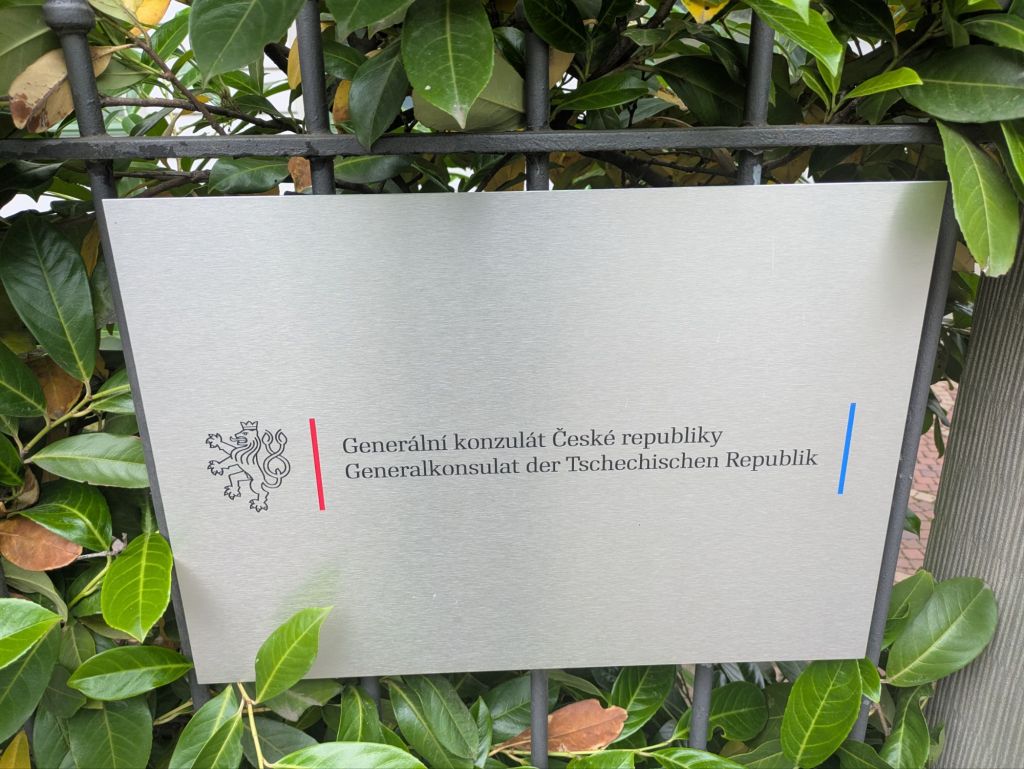
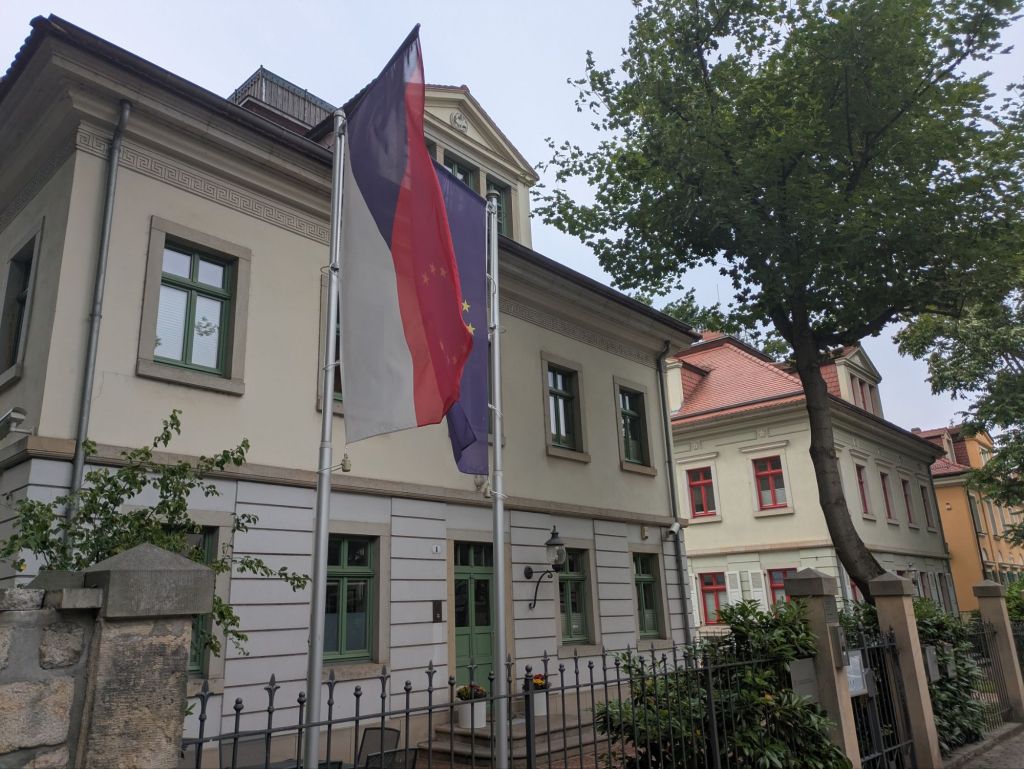
Back in March when I first flew over to Prague, I quickly had to travel up to Dresden, Germany to visit the Czech consulate there in order to be interviewed for the digital nomad program to verify my paperwork, determine my eligibility, and I guess generally figure out if they wanted me in Czechia! It’s a weird requirement to not be able to process the paperwork and do the interview somewhere in Czechia, and Dresden happens to be the closest Czech consulate or embassy from Prague. The interview was pretty intense, frankly, and it took what seemed like an hour (I can no longer recall the exact duration). I kept thinking that the stern lady was going to suddenly interrupt me during one of my answers and shout “Enough! Your application is denied!” But she didn’t, haha. I did try to get her to laugh, or at least smile, but I did not succeed. I was notified of my acceptance in May, but I couldn’t get back to Dresden to get the visa put into my passport until after my Czech language course was finished, and then after the trip to Albania. Strangely, the Dresden consulate sent my paperwork and their interview feedback down to Prague for processing, and then the visa was sent back up to Dresden, to which I was required to travel again in order to pick it up. So much was happening close to me in Prague, but I still had to leave the country in order to follow the official rules. I dealt with a different, younger, lady on the second trip, and she was remarkably friendly and happy to speak English. So it all worked out, and anyway, Dresden is also a very nice city, and thanks to an Asheville friend, I was introduced to a new friend who lives there who generously showed me some cool highlights of her city during my visit in June.
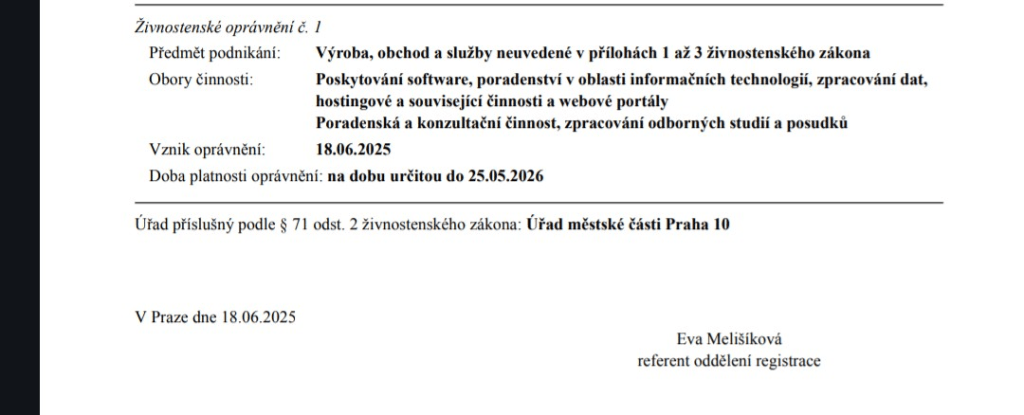
I now also have a Czech trade license, which allows me to serve paying clients in Czechia too, but I don’t plan to because if one earns over a certain threshold while providing services for an EU entity, it triggers a requirement to pay value-added tax (VAT) of 21% for all invoices! I couldn’t just go back to clients after the fact and ask them to pay me 21% more! Therefore, I plan to stick with clients in the US exclusively.
The rules around everything are confusing, and one can find contradictory feedback in various sources (including this one). My understanding from my visa agent is that I will have the option to apply for a two-year residency permit next year, which at its end will be potentially renewable for another two years. After those five total years, one can apply for permanent residency, though permanent residency comes with an additional requirement of passing an A2 (level two out of six, basically) language proficiency test, which includes reading, writing, listening, and speaking portions. After ten years one can apply for citizenship, but must jump through some additional hoops, including needing to pass a B1 Czech language test. It’s a longer and tougher process than in many other European countries. I’m not sure now what I’ll do in the future, but it’s nice to know what the options are.
As a point of contrast, my understanding of Croatia’s digital nomad permit is that it is quite different. Until recently, it was only possible to stay in Croatia with this permit for up to 18 months (now it’s three years), after which the permit holder has to leave the country for six months. And the time in Croatia with the permit doesn’t count towards long-term residency or citizenship. Further, one cannot work for Croatian companies, and private health insurance is required. But the tax situation is much better, as active income for a digital nomad isn’t taxed in Croatia, just passive income is. And the paperwork can be done in English! I really enjoy vacationing in Croatia, but I cannot imagine living there long-term.
Speaking of taxes, I will not be a tax resident in Czechia in 2025, as I won’t have spent more than half the year (>182 days) there. However, I do need to file a Czech tax return in order to be eligible for a long-term residence permit starting in May 2026. Additionally, I’m already paying into public health insurance and social security there. Luckily Czechia is one of the countries with which the US has a reciprocal agreement for not having to pay double taxes and double social security, so I can credit taxes paid in Czechia against my US taxes, for example, and I should be able to get out of paying US social security when contributing to Czech social security.
Residing in two different countries is fun, but it’s not cheap, and it’s certainly not simple! But I like it, and it seems worthwhile for now. “[…] our desire for comfort could be holding us back when it comes to personal growth. If we want to improve ourselves and achieve our goals, we may want to start actively seeking out discomfort.” (Embracing Discomfort Can Help You Grow)
I hope you’ve enjoyed learning a little about what it took to get the Czech long-term visa! I note that if I apply for residency next year, I will be able to do everything in Prague, so no more trips to Dresden will be required. In a future post I plan to write about the additional logistics for living and working in Czechia, including setting up a bank account, paying taxes, getting insured, paying into social security, setting up a “data box”, obtaining a Czech phone number, maintaining a residence and mailing address, having a business virtual address, and more!
Today’s dad joke:
90% of bald men still own a comb. They just can’t part with it.
(seen in local Fairview, NC paper)
Today’s Czech word:
Předvčerejškem — “day before yesterday”
Today’s music video:
I recognize that I share videos with music you may not like. But I must say, I’m sad that I missed this Epica concert in Amsterdam, as one cannot beat the combo of a symphonic metal band with a backing full symphony and choir! This is perhaps the most chill-bump-inducing song and video I’ve ever had the pleasure of wrapping my senses around. I sure wish I’d been there that night… You don’t have to like this performance, but I bet you’ll at least respect it!
Today’s Epictetus:
Books are the training weights of the mind.

 Major Meander
Wow, what an ordeal! Sounds like you navigated it successfully though and got lucky with a great visa agent too. All part of the adventure 😀 Looking forward to part 2!
Thanks! Yes, tourist visas are much, much simpler, haha! I hope your upcoming explorations are great fun! Perhaps you’ll find a place where you want to return often.