
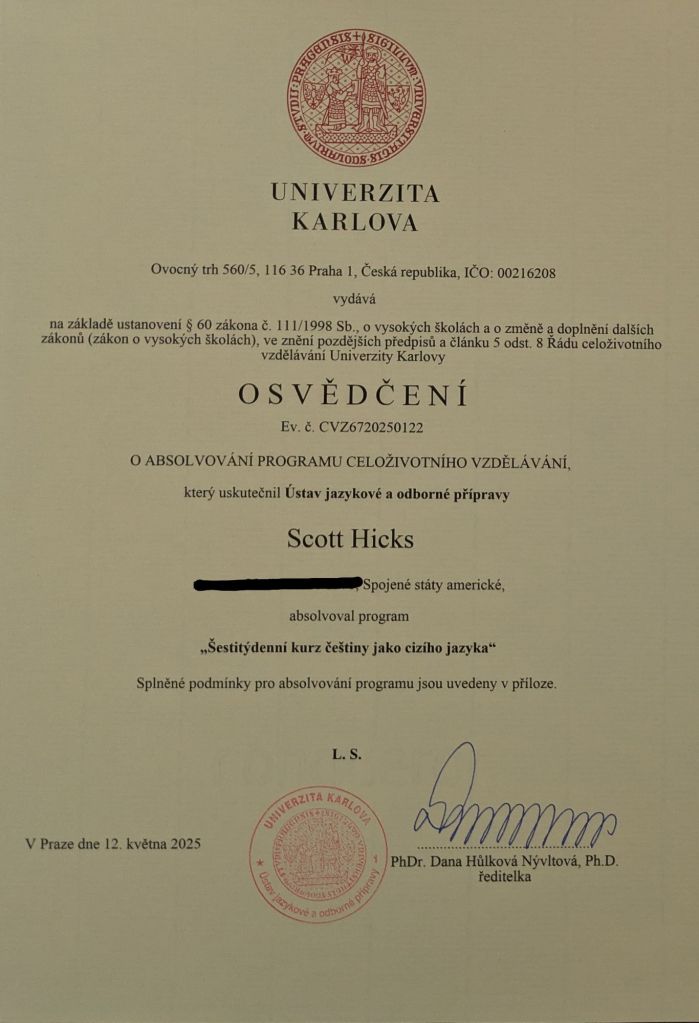
I’m done with the 30 days of intensive and immersive Czech language learning!! Yay! Phew, what a relief. The photo above is of me smiling while overlooking the city. Pleased to have done it, happy to be finished. I’m still getting used to not having to go to class or do homework, though the sound of the teacher’s voice saying her most common phrases continues to rattle around in my head.
She is a level-headed instructor, though this week she seemed to get a bit perturbed that many of us (me included) keep forgetting that “CH” is considered to be just one letter in Czech. It continually threw me off in crossword puzzle exercises. I made that mistake so many times. I also kept getting the informal and formal “you” verb conjugations backwards, for some reason, even on the 30th and final day of class, haha.
Over these weeks I’ve heard numerous first- and secondhand stories of people learning Czech for months up to even several years, and still needing to sometimes or often revert to English to communicate sufficiently. I know that linguists bemoan the loss of languages around the world, of which there are estimated to still be 6,000 to 7,000! But it does seem like it would be so efficient to be able to communicate with everyone around the world in just one common language. And it could be a secondary language so that folks could still have their first language and potentially others. Esperanto is a constructed language that is meant to serve exactly that purpose. It was created to be logical without all the random complexities of natural languages, and without difficult conjugations, and without cases, gender, or tones. It’s got a simple alphabet and is easy to pronounce and learn, with a system of derivation which allows for simple combinations of prefixes and suffixes with root words to create meaning, without a requirement to learn a large vocabulary. It is estimated that there are only 100,000 speakers of Esperanto, so despite its creation in the 1800s, it hasn’t found widespread adoption. That said, it is the most widely spoken constructed language. So what’s the solution? Can we leverage a language with a simple alphabet, without difficult conjugations, and without cases, gender, or tones? Well, yes, how about English?! And guess what, there are over 1 billion English speakers around the world! English is actually only a distant third in the number of native speakers, but it’s in first place in terms of total speakers. The main two problems with English are its awful phonetics and spelling, along with native speakers’ use of idioms. Consider all the various examples of American English idioms from just the sport of baseball, such as a “ballpark figure” and “cover one’s bases.” And spelling is atrocious. Czechs would have very boring spelling bee competitions because everything is phonetic.
Speaking of constructed languages like Esperanto, I recently learned about another constructed language, this one called “Interslavic“. It’s meant to provide a strong baseline sufficient to communicate with native speakers of the various Slavic languages, such as Czech, Polish, Russian, Ukrainian, Croatian, etc. That sounds like a great idea. Perhaps I should learn Interslavic instead of Czech!
I first heard about Interslavic from a polyglot gent I met on a hike with a mutual friend. In fact, of the seven people on that hike, five are in a polyglot group where they get together to practice their various languages. A polyglot is someone who knows several languages. For example, I overheard someone recently ask a friend how many languages he can speak, and he said seven! The polyglot noted that he didn’t count Czech or Slovak, both of which he knows very well! So that’s actually nine. He goes to polyglot conferences where he meets people who speak even as many as 20 or more! To maintain vocabulary and grammar, polyglots often meet in person and/or online to practice across various languages. So two native Czechs might speak both French and German with each other for practice, for example. When people in my Czech class were asked by the teacher which other languages they spoke, most forgot to even mention English, even though all but the Chinese gent spoke English! Learning multiple languages well is a cultural and practical thing that relatively just isn’t all that prevalent in the US, alas. Especially when we already speak the de facto Esperanto and can travel thousands of miles and kilometers without ever leaving our own English-speaking country.
I learned this week that the word for both leg and foot is the same in Czech (“noha”). There’s also one word for arm and hand (“ruka”). I’d never seen that lack of differentiation before in a language. In Swedish it’s “ben”, “fot”, “ärm”, and “hand”. No one’s saying that Swedish is tough for body parts for an English speaker. German is similar with “Bein”, “Fuß”, “Arm”, and “Hand” – these Germanic languages are clearly related. Spanish has “pierna”, “pie”, “brazo”, and “mano”. One thing that Spanish does that I like is call toes “fingers of the feet” (“dedos de los pies”). Czech is similar with “prsty na nohou” – fingers on the feet/legs. In Swedish a toe is called “tå”, which basically sounds the same as in English.
I have come to realize that not only are the seven cases in Czech challenging on their own, but there are also various situations in which one must additionally recognize which case to use even when things look similar. For example, we recently learned that four different cases are used for indication of “where?” or “where to?”
So for “where” (“kde”), if one is “in” or “on” something/somewhere, the locative case is used for the adjective(s) and noun for that place. But if one is “at” the doctor’s or “near” the sea, the genitive case is appropriate. For “where to” (“kam”), if you’re going to a physical location, the genitive case is used. But if going to an event (like a party or concert), the accusative case is leveraged instead. And finally, if going to the doctor’s or to someone’s place or near someplace, then the dative case is used. That all seems almost hilariously impossible! Maybe one gets used to it over time?? Use of appropriate prepositions is always a challenge in languages, but Czech then takes it up multiple levels from there.
One of the unforeseen disadvantages of learning Czech is that I’ve discovered that Czech kids say basically the same as what I suppose every little kid does everywhere when whining. Things like “That’s mine!”
Today’s Prague and Czechia tidbits:
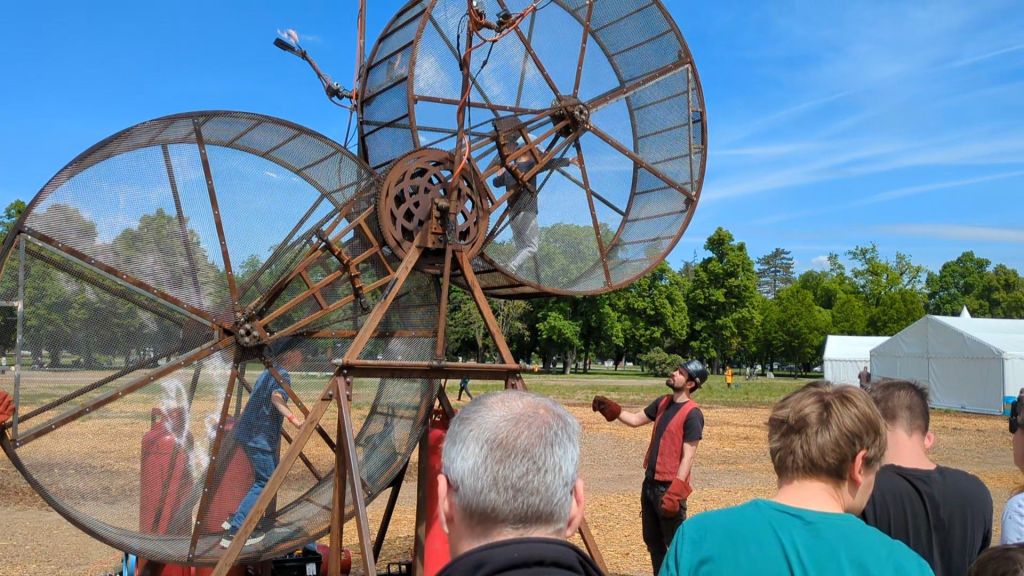
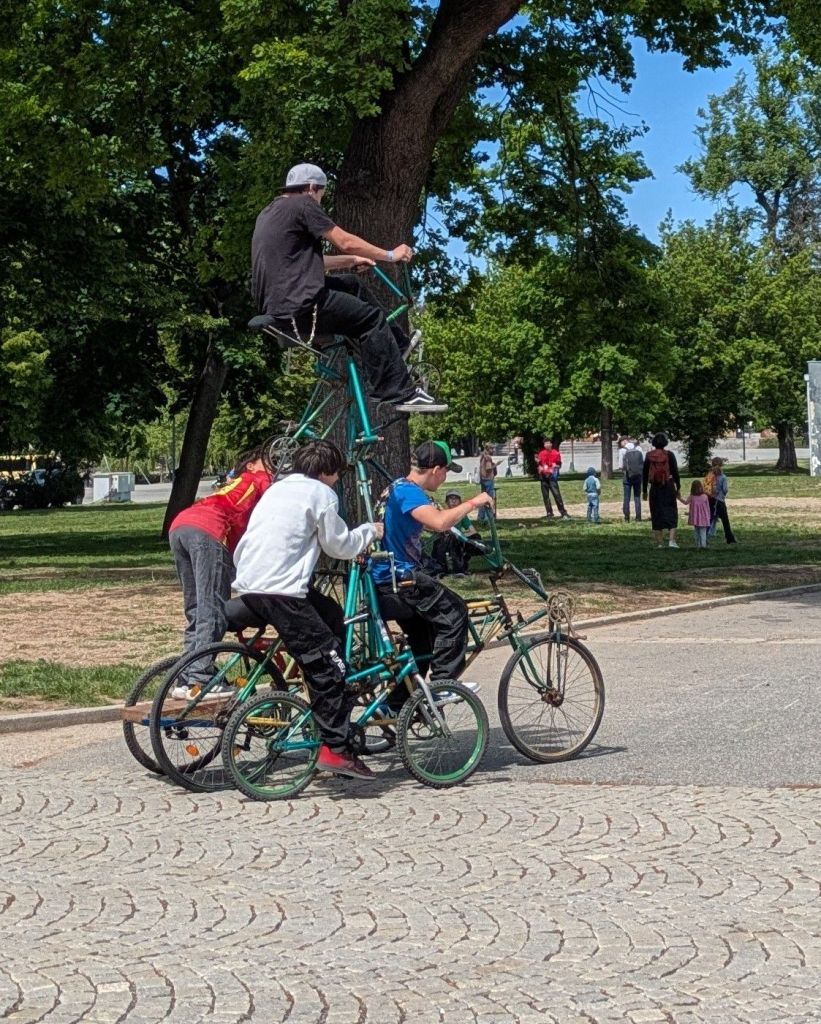
There was a Maker Faire exhibition in Prague recently, and when I walked through the free outdoor portion, I found a handful of unique creations, such as a robotic band playing a stage show with drums, keyboard, and bass, along with a two-level four-seater bike! Further, there was a pair of what appeared to be giant hamster wheels, connected together and with one young boy in each, spinning these wheels by walking.
Radio Free Europe, a media group which broadcasts news and analyses in 27 languages to 23 countries, was founded in 1949 and originally targeted Soviet satellite states. It is now headquartered (since 1995) in Prague. Media is provided across dozens of countries in Eastern Europe, Central Asia, the Caucasus, and the Middle East. Its funding from the US government has now been suspended under a directive from the Trump administration. It seems like a mistake to create a vacuum in these regions into which Putin’s propaganda could be sucked.
Prague’s “New Town” was founded in 1348. “New” is a relative term!
There are free water taps all over the city, especially in the parks. I bring my water bottle when out and about, and refill it when needed. You just have to know where to find these sources. One way to do so is the mymizu app, which I learned about while in Japan (“mizu” means “water” in Japanese).
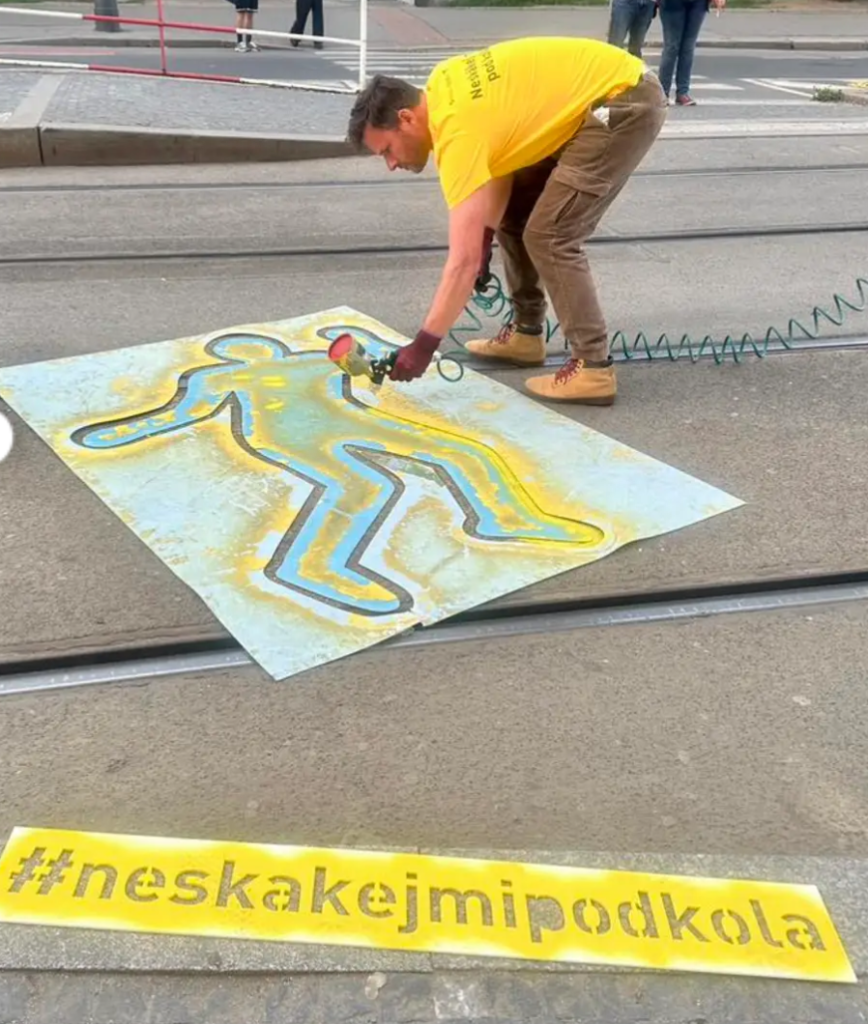
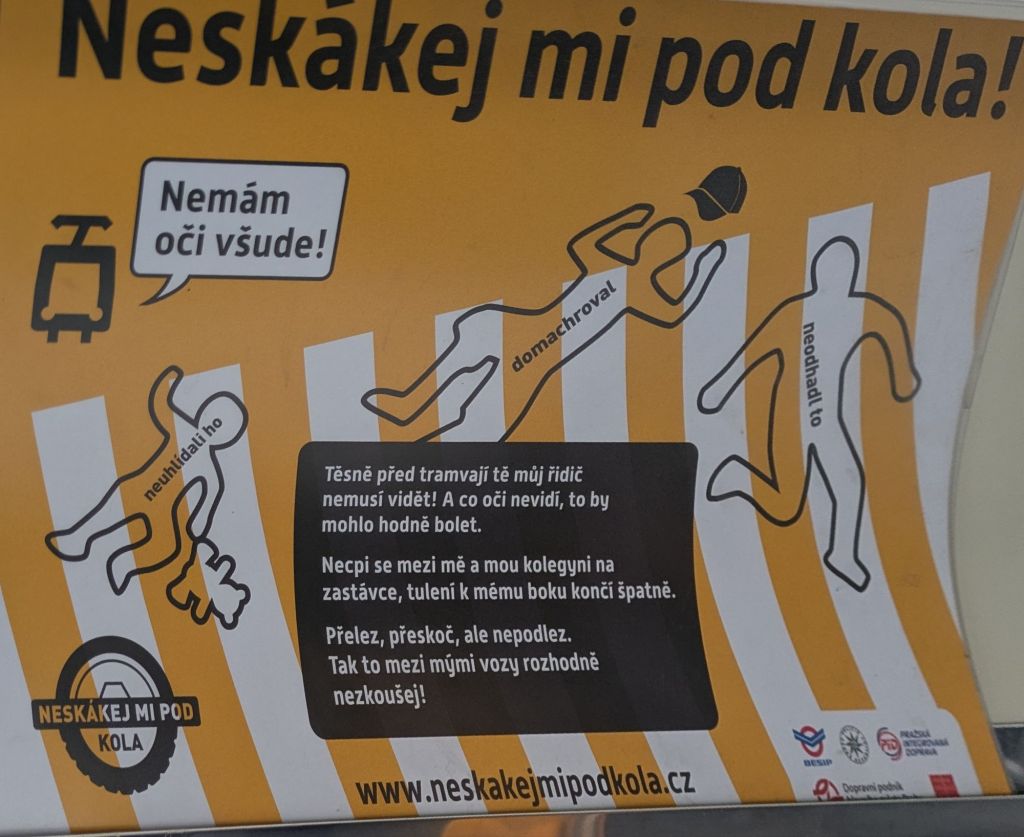
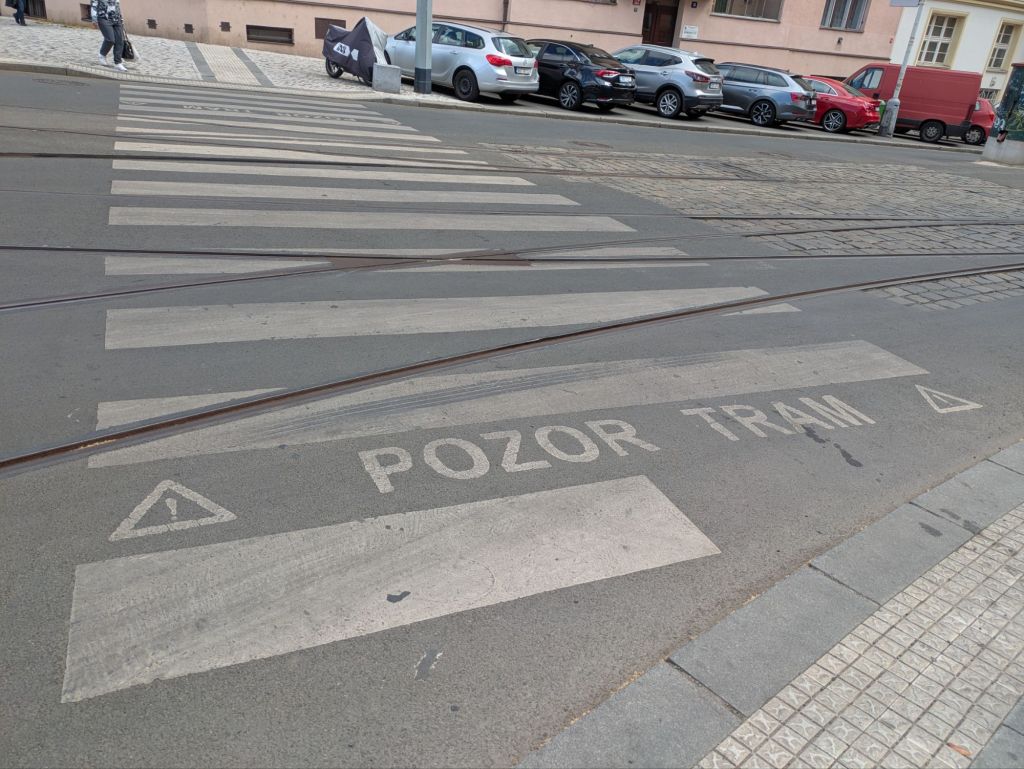
Every year people are unfortunately struck by trams in Prague. The city has an extensive system with trams passing regularly at each stop. At some intersections you’ll see a handful of trams passing at once. Prague is known to have an excellent and affordable public transport system. A tradeoff with trams is that they drive along the roads and don’t stop for pedestrians. They often travel quickly, and it’s easy to be surprised by a tram coming around a corner. I’ve not seen an accident myself, but I’ve seen a lot of close calls with cars, pedestrians, and electric scooter riders. The tram drivers ring a bell in warning, but sometimes reaction times aren’t fast enough. You can find videos online of trams smashing into vehicles. The transport folks began a public service campaign, painting “victim” outlines at some of the most dangerous tram areas. In April a 12-year-old boy was tragically hit and killed when he stepped in front of a tram.
One weekend when I took a train to get to a small town with a castle, a portion of the train route was closed, and so riders were told that we’d need to take a replacement bus to get us around the closed portion. Upon arrival at the station where we had to exit the train, I had presumed that I would just follow the crowd. But unfortunately people scattered in multiple different directions. In the distance I saw one bus parked alone, so I and a couple of other guys made our way over to it. When we got there, the entrance doors were closed, and there was no sign of a driver. We looked around in confusion, and luckily a train station worker came over, got on his tiptoes and looked into the back of the bus, and then rapped on the window. The bus driver had been asleep in the back! When he was awakened, he got up and came to open the doors and start up the bus. Surprisingly he also had a little pet dog with him which wandered around the bus as we were driven to the next station.
Czechs recently got together and repaid travel expenses for a 99-year-old American World War II veteran who traveled over to Pilsen to commemorate Liberation Day festivities! Good for him, and good for them! https://www.expats.cz/czech-news/article/czechs-rally-to-repay-travel-expenses-for-us-wwii-veteran-s-return-to-pilsen
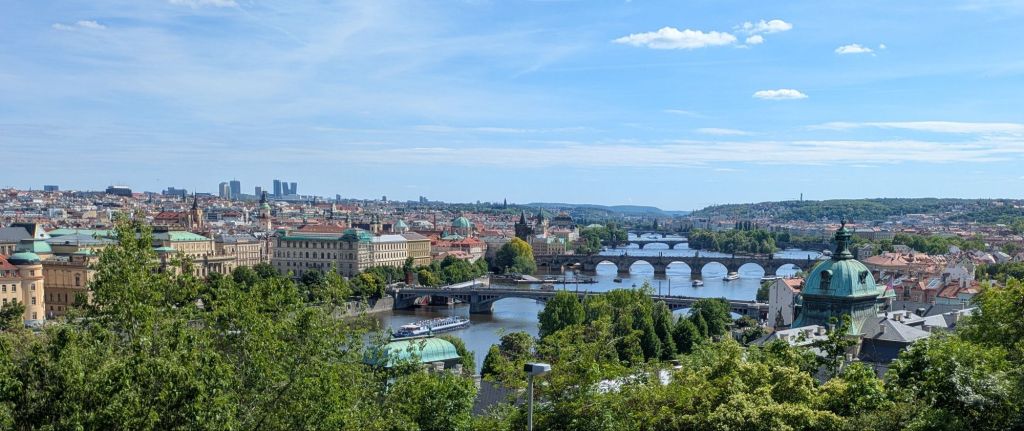
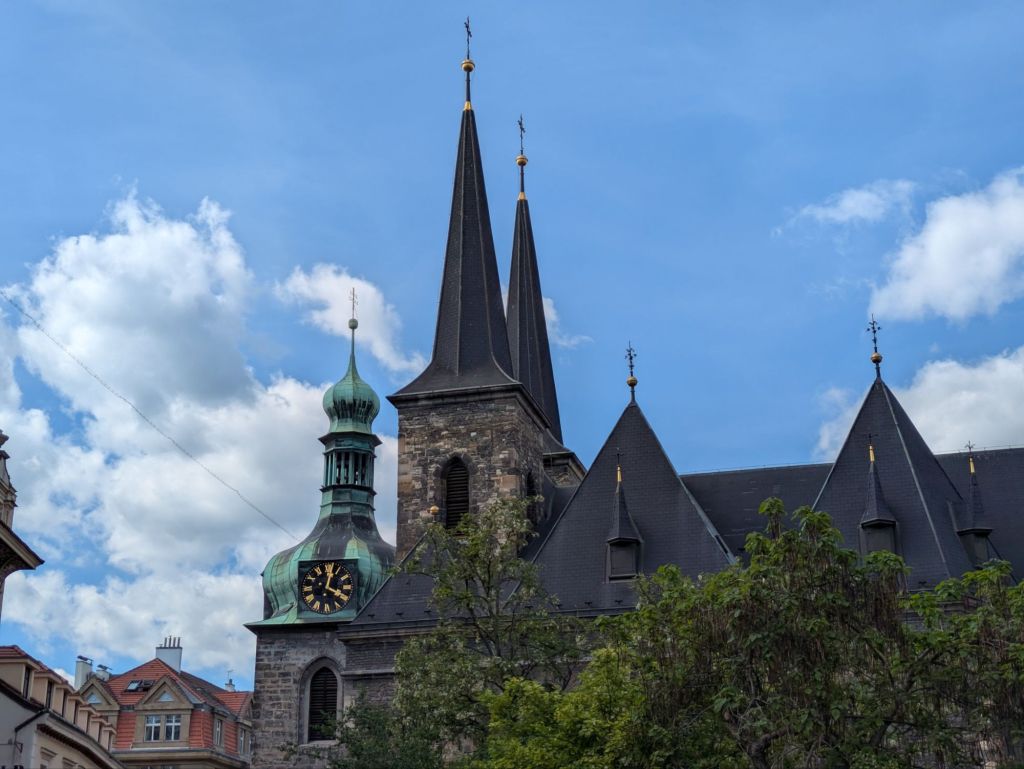
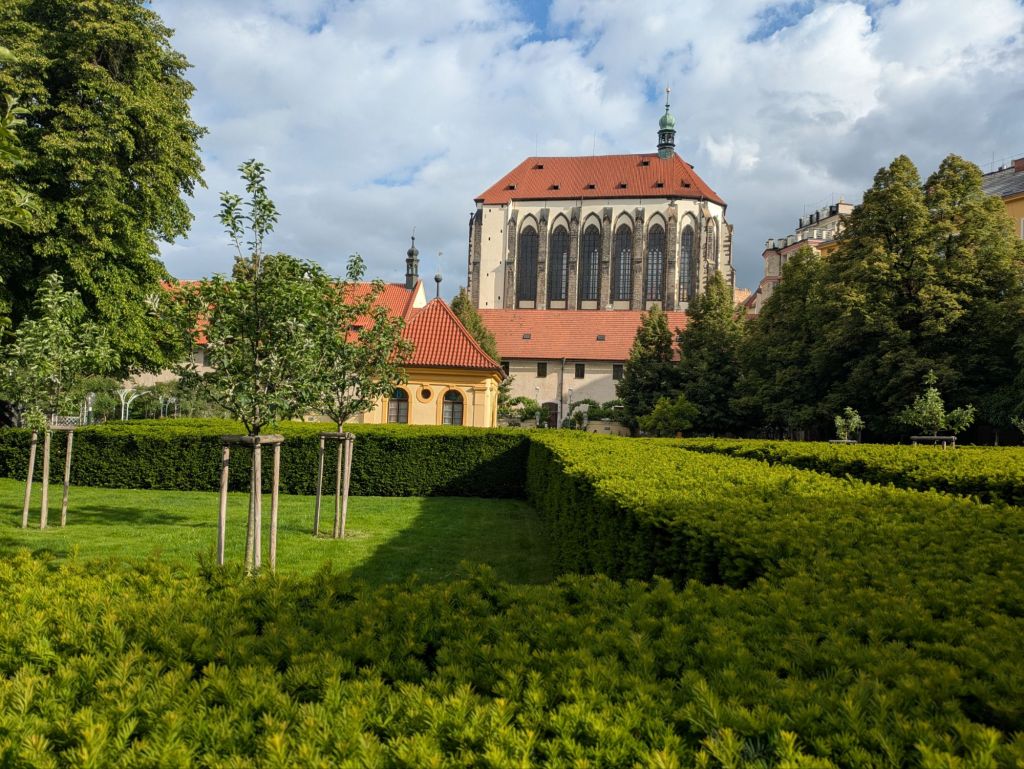
Today’s Prague photos:
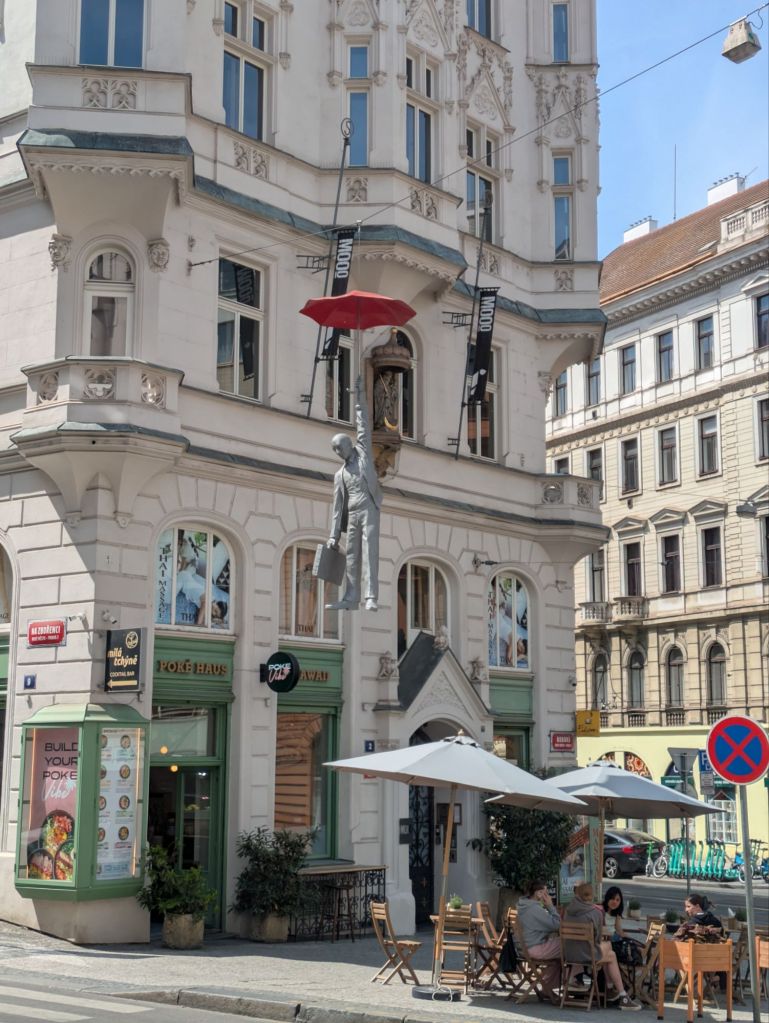
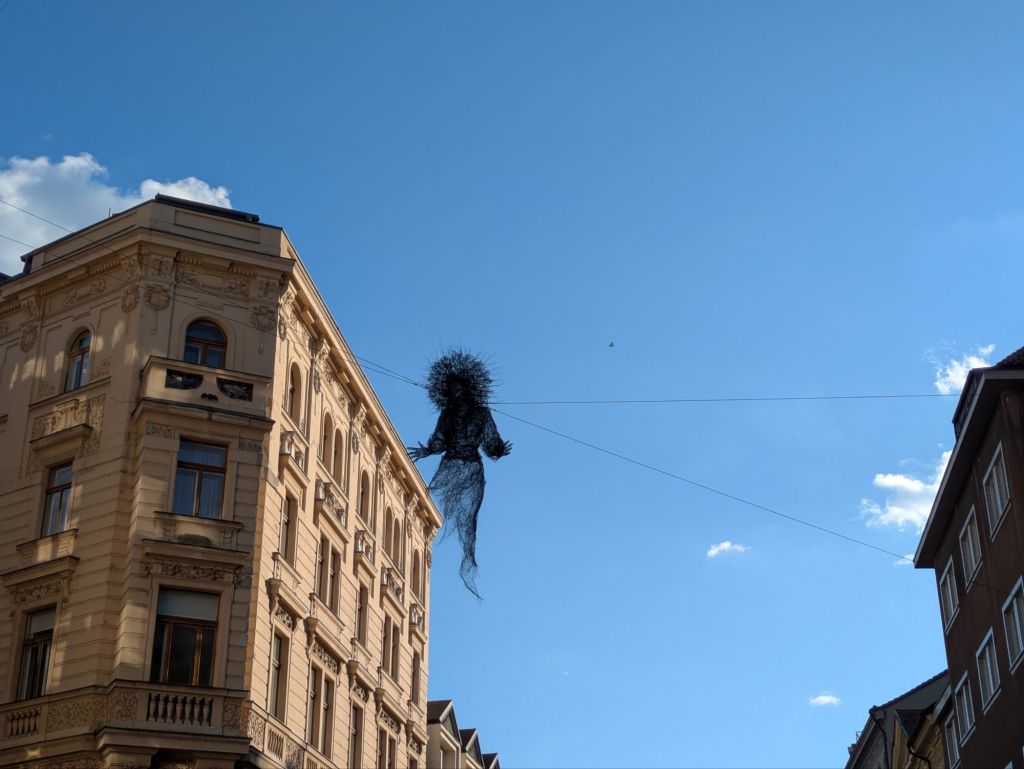
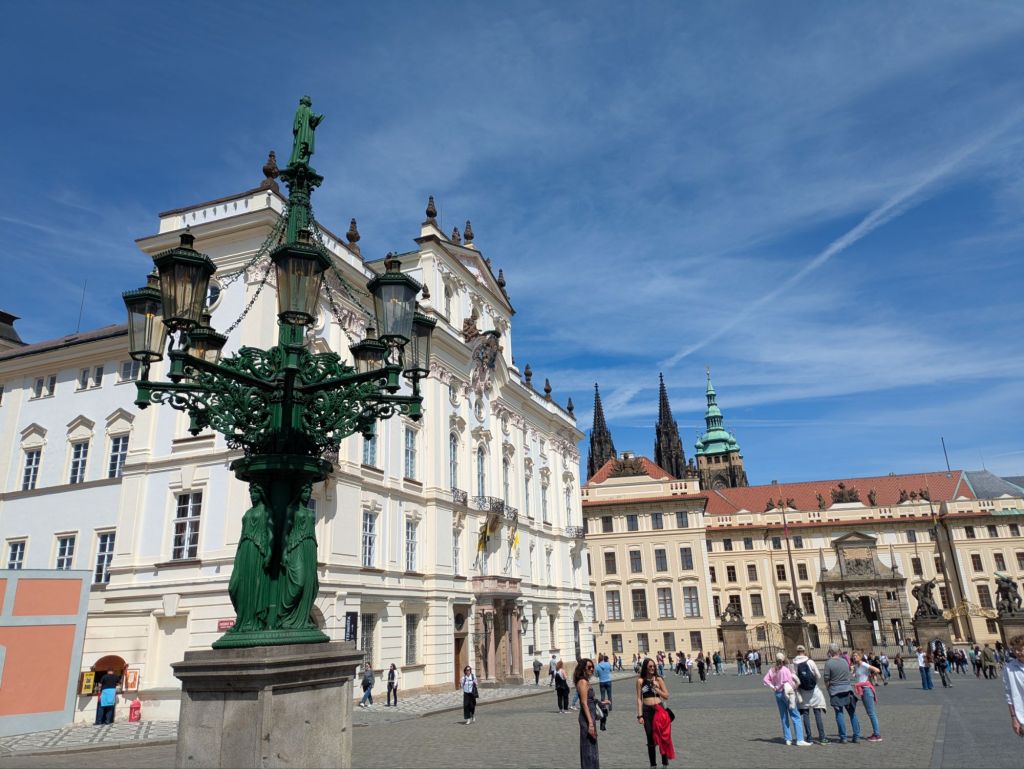
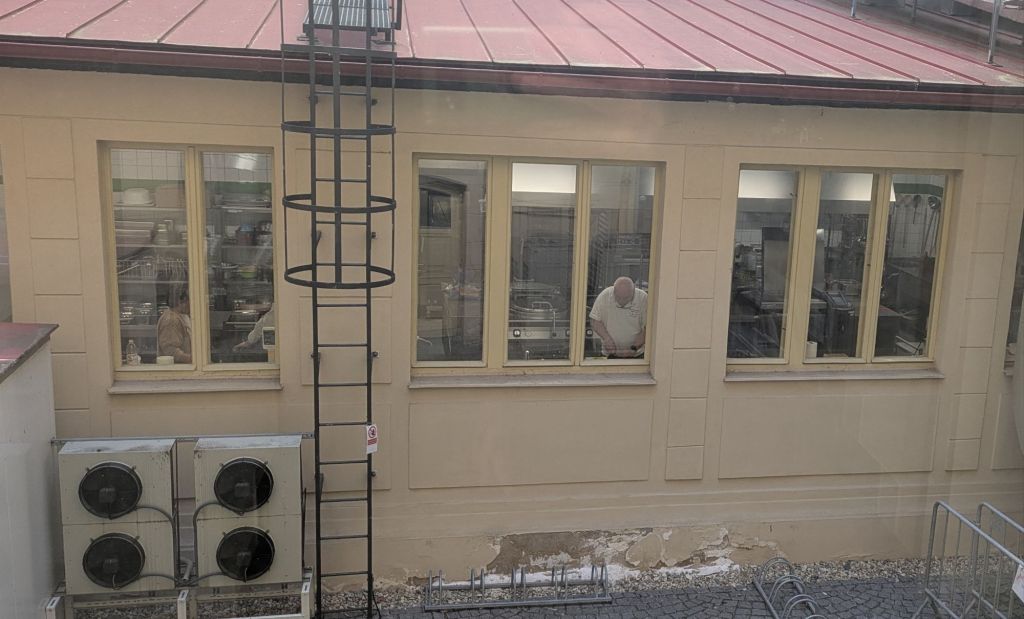

Today’s DadGPT joke:
I wanted to be a baker…
But I couldn’t make enough dough.
Today’s funny video:
The Irish lads are back. Nothing Japanese from me today.
Today’s Epictetus:
No matter what happens, it is within my power to turn it to my advantage.

 Major Meander
Hurray for you! What is your next language quest? I loved the video. I think it makes learning the periodic table fun!
Maybe Hindi! Those guys’ videos are always funny. 🙂
Congratulations! 🎊👏 That’s quite a feat. All Czech people must be smart just to learn their language. It seems like a great way to train a growing brain. Also, I can’t help but wonder if there’s a segment of society who struggles with the language, even into adulthood?
That’s a great picture of you! What a smile!
Very true! I can think of various mistakes native English speakers make in English (I include myself here), but there are almost infinitely more opportunities for mistakes in Czech. So one could presume that mistakes are often made. I wonder how judgemental people are about it. I should ask around!
Scotte, CONGRATS on completing this challenging course. To je paráda!
I’ve had so much fun reading your articles with all their details about language – it brought back memories of my own experiences and struggles in a similar course at the same university about 30 years ago! I still remember my strict teacher, Alicia, and how she tried to hammer those verb inflections and case declensions into our brains. Our minds were still young and flexible, but often exhausted from pub crawling, as we slowly got to know the many attractions of this outstanding city.
So I was happy – and surprised – to see that I could still recognize some ot the structures and phrases from your exlanations and the photos of your class material. It even gave me the impulse to take it up again (still thinking about it…) since the Czech border is only an hour away from me, and it would make so much sense!
Generally, I was just baffled by what you’ve achieved as a human being – doing this intense language course, having a consulting job afterwards, joining a running club twice a week, and going hiking on the weekends. And on top of that, you’ve been writing this blog regularley, with deep insights not only into the Czech language itself but also into everyday life in Prague. You seem to step out onto the street with your brain wired to hundreds of antennas, taking in all the vibes of your surroundings! I enjoyed the pictures, linguistic comparisons, jokes, and hilarious videos, which I suppose require a certain extent of research and don’t just come off the top of your head. To je super! (My Czech is so limited!)
Pozdravy z Drážd’an od Sabiny
Thanks for these kind words, Sabine! I’m somewhat surprised that you’d entertain relearning Czech after reading about my experiences, haha. I’m relieved to be done with the course, and tomorrow I head out for a two-week vacation! I feel like I need it. 😁
Another super post, Scott! Thanks for taking the time to share your insights and progress with us. Congratulations, also, on completing the course. I’m curious if you feel that you’re happy with your progress, and where you are compared to your original goals. The time we had together with Sabine was fun, also, she’s a bright lady and is messaging me in French these days. Hopefully you guys can hang out a bit. Love all the pics, and looking forward to what you have for us next! Joe
Thank you for this nice sentiment, Joe! I tried my best in the course, and I don’t feel I could have realistically done any better. Beforehand I had hoped we would reach level A1, but quickly learned that we wouldn’t. In other simpler languages such as Italian, Norwegian, or French, we would have surpassed level A1. I’m planning on meeting Sabine in Dresden for lunch in June when I go to pick up my long-term Czech visa!