
Whew, 33% done with the course! “Intensive” is an apt descriptor for this immersion course. Thinking about it, the course is 150 hours of instruction time, plus about 50 hours of study and homework time, so ~200 hours total of Czech language focus. And yet… Czech is so difficult that even that amount of dedication does not suffice to reach the first certification level indicative of an acknowledgeable grasp of the language. According to the Common European Framework of References for Languages (CEFR) system, there are six levels of proficiency: A1, A2, B1, B2, C1, and C2. I had hoped, and really expected, that after 200 hours of Czech work I’d be able to pass the A1 level certification exam. The A1 level is meant to be quite basic:
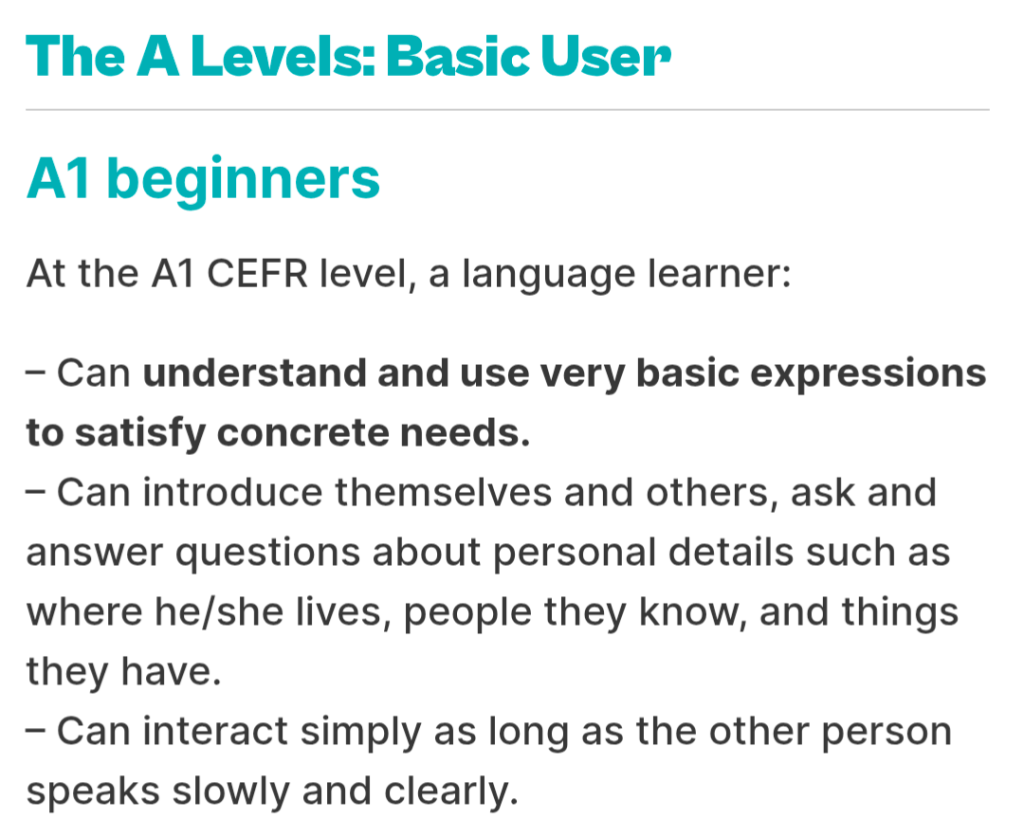
However, to my surprise and disappointment, the instructor told me that no, we probably wouldn’t actually complete all the lessons needed to reach A1 proficiency! Amazing. Just envision how strong one could become in almost any other topic or field if dedicating that much time to learning, study, and practice! This course is more difficult and time-consuming than any of my graduate degree classes, and wow, is it humbling! No big ego is possible when one is at such a rudimentary level at something like this. My homework and classwork papers resemble blood-soaked bandages from an emergency room, with red ink splattered all over my error-riddled submissions. When called upon individually the 15 to 20 times during each class, I stumble over pronouncing words, I use the wrong pronoun, I misspell words when writing on the board in front of everyone… But then again, so does everyone else! At least I’m not the weakest link in the class, though I did once mistakenly write “kau” instead of “kávu” on the board, to the great amusement of the class because it sounds like “cow” (not the actual Czech word), and so I wrote something like “I would like a ‘cow’.”
But to not even reach A1 does make me question how far I’ll realistically get with my Czech. Charles University teaches to all levels, but I don’t know yet whether I’ll take another course:

Here’s a link to the details of this particular 6-week course:
https://ujop.cuni.cz/UJOPEN-74.html?ujopcmsid=50:intensive-czech-course-for-foreigners-6-weeks
There is an 8-week course as well, which I considered, but it seemed too long. Though I suppose that it would have provided the depth to reach A1. In any case, I have all the materials to reach A1, so could take my own study time to try to reach that as a goal. Something to consider later. For now, I’ve got all I can manage on my plate.
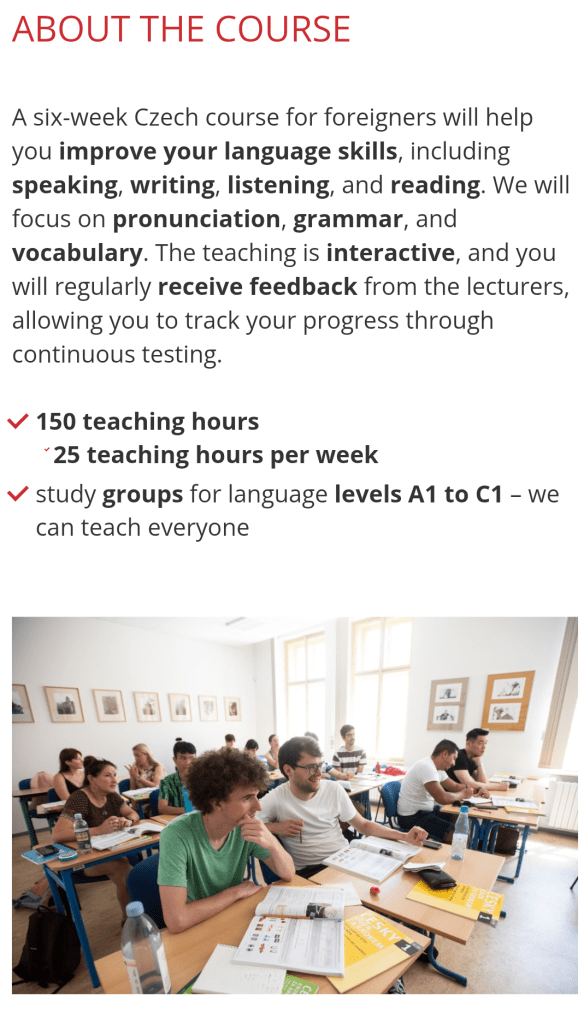
Our classroom is smaller than the one shown in the image below, but it’s very similar:
As we’ve progressed, I’m frankly impressed that the Germanic language speakers (English is a Germanic language) and the Chinese guy have been able to mostly keep up with the Russian and Ukrainian speakers. On Thursday we learned a few dozen new common adjectives, and I leaned over and asked the Belorussian lady beside me how many of those are similar or the same in Russian or Belorussian, and she said all of them! (Side note: If you’re curious about the use of Russian and Belorussian in Belarus, this is a good overview.)
These adjectives are words like krásný (beautiful), ošklivý (ugly), tlustý (fat), and zlý (mean), which are definitely not similar to the corresponding English terms. No cognates there. On Friday morning the instructor brought us all up to the front of the class for an exercise where we needed to know the dozens of adjectives, and the Swiss guy, the German guy, and I all brought our notebooks with us as references because we hadn’t yet memorized all those new words, but none of the Slavic speakers did (they didn’t need to), and to his great credit, neither did the Chinese guy!
Luckily there aren’t actually that many “false friends” in Czech, because the language is so different. There are many good examples of false friends in Swedish, such as the classics “slut” and “bra”. But there is a tricky one we’ve learned in Czech – the word “host” means “guest”! So at a restaurant the customer is the “host”, and the server is the “číšník” (I won’t be confusing that one with anything in English).
I’ve been connecting with the Germanic guys better than with the others, which I suppose makes sense – they have the best English. The Swiss guy is particularly funny. As I noted in a recent reply to a reader comment, he told me this week that he ordered coffee for himself and a friend in Czech, but instead of saying “we would like…”, he accidentally said “you would like…” to the server! Also, I showed him the “strč prst skrz krk” phrase from my previous post, and he knew it! His father is Czech, but never taught the language other than this particular phrase and little else, haha! What a coincidence. This Swiss gent also lived and worked in Greenville/Spartanburg for seven months some years ago, and has visited and enjoyed Asheville.
Last summer my family spent a lot of time in hospitals here in Prague, and I learned then that a hospital is called “nemocnice” in Czech. When the students learned adjectives this week, one new adjective was “nemocný”, which means “sick”. So I asked the instructor if the -ice ending of nemocnice means “place,” such that nemocnice means “sick place” – she said basically, yeah. Makes sense!
Before the course began, I was delighted to host my good friend Joe in Prague!

Today’s Prague insight:
10 eggs are $2.35. And yes, eggs are sold in packs of 10, not 12.
Today’s dad joke #1:
This one’s from me:
Why did Misty work at the marine mammal sanctuary?
Because it gave her a porpoise.
Today’s dad joke #2:
I read this one recently in the local Fairview Town Crier, and I really like it:
A group of chess enthusiasts checked into a hotel and were standing in the lobby discussing their recent tournament victories. After about an hour, the manager came out of the office, and asked them to disperse.
“But why,” they asked. “Because,” he said. “I can’t stand chess-nuts boasting in an open foyer.”
Today’s music video:
I’ve remained mostly quite underwhelmed by Czech music, other than classical, of course. Pop and rock are frankly mostly pretty awful here, at least to my ear. Perhaps I’ll find a diamond in the rough, but it hasn’t happened yet. Luckily, music is global nowadays, and with the internet it’s straightforward to find music from anywhere on Earth. And after the trip to Japan last year I’m really into some of the tunes from the Japanese band Atarashii Gakko. Their “Change” is currently my favorite song, full stop. The official music video is entertaining, but their dance practice video, apparently taken from a phone camera, really captures their contagious energetic and fun vibe. Whenever I need an energy boost, I pull up this song. Both videos are worth a watch, but I put the practice video here first:
Today’s Epictetus:
It is impossible for a man to learn what he thinks he already knows.

 Major Meander
Love the picture in Old Town Square of you and Joe! And – your brain must be getting the biggest massage from this jump-in and being in the hot seat approach. Just like being back in college! What interesting people you’re meeting as well.
Thanks! As the Czechs might say, I’m just taking care of byznys.
😂
The effort involved in this class makes me tired just reading about it. Kudos to you for this effort.
I just awakened from a three-day nap, haha!
Loved reading about your week. Makes me laugh that I’ve been taking level 2/3 Spanish courses for much of my life. Also interesting that I remember a fun selection of phrases and words in Gourmantché and Moré, 2 languages they speak in Burkina where I lived in west Africa. I’m quite impressed by the brain work that you’re doing! Inspirational.
How cool that you learned African languages! Those two languages aren’t ones I know anything about. How difficult are they?