On Sunday I visited the factory where Oskar Schindler helped keep many Krakow Jews alive, and he is credited with saving 1200 total. The museum is very well put together, and it’s super-informative, with lots of interactive exhibits and touchscreens where you can dive deeper. You could easily spend a few days there just absorbing it all, so you have to pick and choose. Or you just wear out from learning more and more about the sheer terribleness of the Nazis’ actions in Poland, like I did. Geez, there were some horrible people doing such horrible things.

I opted out of visiting nearby Auschwitz because I’ve been there before, and it’s not somewhere I wish to see twice.
I learned that only in Poland did the Nazis say that helping Jews hide was punishable by death. From what I’ve seen, the Nazis were perhaps most horrible of all in their controlled area of Poland.
Poland was the center of Judaism in Europe for a long time, and 400-500 years ago, Poland had half of all the world’s Jews. A quarter of Krakow was Jewish until after the Nazis arrived.
Only a few thousand Kraków Jews survived the war. During the communist era, this waning population was ignored or mistreated. After 1989, interest in Kazimierz’s unique Jewish history was faintly rekindled. But it was only when Steven Spielberg chose to film Schindler’s List here in 1993 that the world took renewed interest in Kazimierz. (A local once winked to me, “They ought to build a statue to Spielberg on that square.”) […] the current Jewish population in Kraków numbers only 200.
Rick Steves
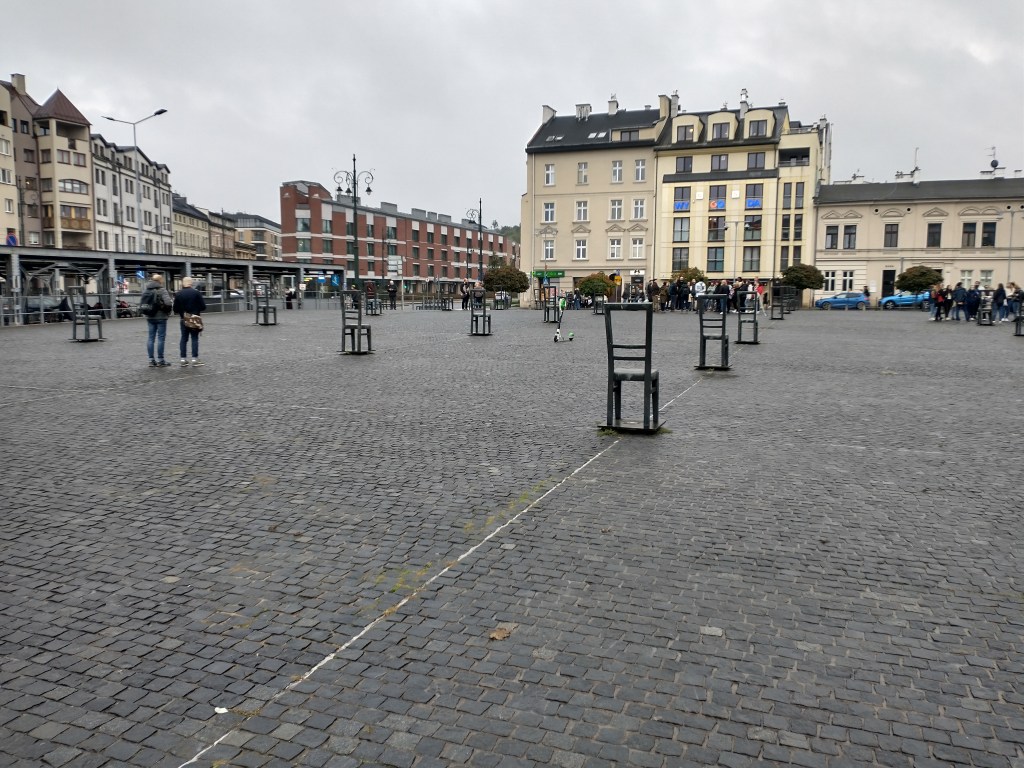
There is a square, not far from the Schindler factory/museum, filled with a monument consisting of 68 empty metal chairs, with each one representing 1,000 people deported from Krakow to the ghetto here on the south side of the river. The Jews were forced to carry all of their belongings, including furniture like chairs. Many Jews were later sent from here to extermination camps.
Today’s dad joke (to lighten the mood): What’s a really attractive person from Krakow also known as?
A magnetic Pole
Today’s travel quote:
Travel is more than the seeing of sights; it is a change that goes on, deep and permanent, in the ideas of living.
Miriam Beard

 Major Meander
The Nazi atrocities are a stark reminder of one of the reasons that history is important: to ensure that we learn from the past.
Very true. A quote from my current favorite author, Yuval Noah Harari: “Even if war is catastrophic for everyone, no god and no law of nature protect us from human stupidity.”
I like that quote *whoever saves one life saves the world entire,” and have heard similar, like “what you do to one you do to all.” Thank goodness for brave and compassionate people like Schindler! The people in those countries have to live with the shadow of this for so long – and you see references to it so frequently in the cities with plaques and monuments, art installations and musems. It casts a long, cold shadow. War is no joke.
Woof, cold cup of coffee. I only vaguely remember our trip to Auschwitz because it was so much to process. Preserving and telling these stories are so important: thanks for sharing.